
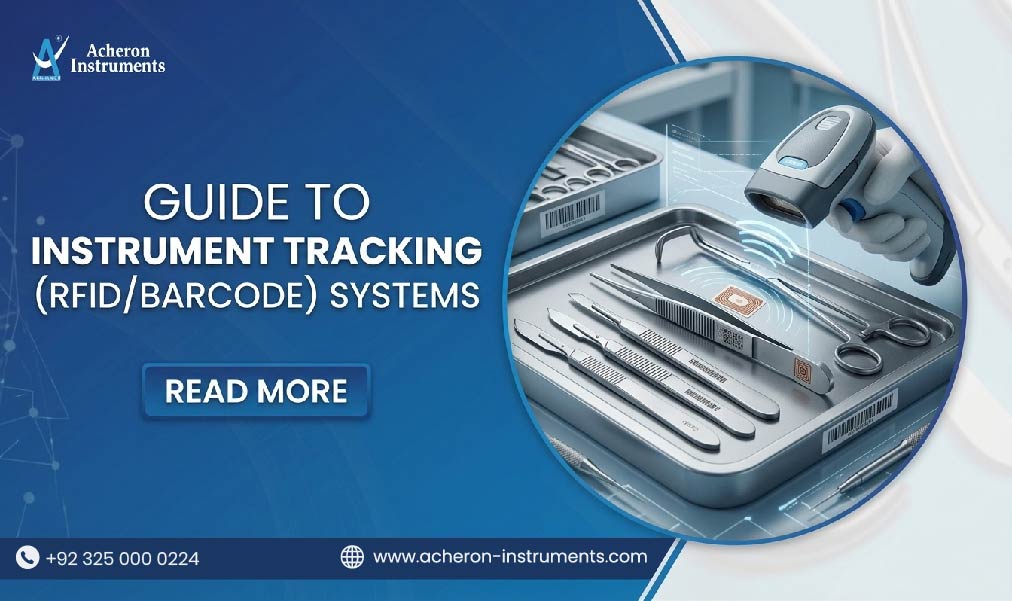
Every year, thousands of surgical instruments are lost, misplaced, or left in the wrong place at the wrong time and, in the worst cases, left inside a patient. An instrument tracking system built on RFID, barcode, or a hybrid of both solves this problem by giving every individual instrument a unique digital identity that can be scanned, located, and audited in seconds. Moreover, this guide explains how barcode and RFID instrument tracking systems work, their differences, key components, regulatory considerations, implementation steps, common challenges, and how to select the right solution for a healthcare facility.
What Is an Instrument Tracking System?
An instrument tracking system is a combination of identification technology, software, hardware, and workflow processes used to track reusable medical and surgical instruments throughout their operational lifecycle. Instead of relying on manual logs, spreadsheets, or memory, each instrument is tagged with a unique identifier, such as a printed barcode, a data matrix code, or an embedded RFID chip, which is scanned or read at every key checkpoint. Depending on the system, each instrument or instrument set receives a unique identification code. That code can be associated with information such as the following:
-
Manufacturer and model
-
Serial or identification number
-
Instrument set information
-
Location
-
Processing history
-
Sterilization cycle information
-
Maintenance and repair history
-
Inspection status
-
User or department
-
Usage history
-
Replacement or retirement information
Furthermore, at its core, the system answers four questions in real time:
-
Where is this instrument right now?
-
Who last used it, and when?
-
Has it been cleaned, sterilized, or calibrated, and when is it due again?
-
Is it part of a complete set or tray, or is something missing?
This same instrument tracking technology underpins tool crib management in manufacturing, asset tracking in laboratories, calibration tracking for metrology equipment, and inventory control for rental equipment fleets.
How Barcode Instrument Tracking Works
Barcode-based tracking is the most widely used instrument tracking technology today, and for good reason: market data consistently shows barcodes holding the largest revenue share globally, generally cited at roughly 40% to 66% depending on the region and instrument category, thanks to their low cost, simplicity, and compatibility with existing infrastructure.
How it works step by step:
-
Labeling: Each instrument or tray receives a unique 1D barcode or 2D Data Matrix code, laser-etched directly onto surgical-grade steel for reusable instruments that undergo repeated sterilization, or printed on a durable adhesive label.
-
Scanning: At each workflow stage, staff scan the code with a handheld or fixed-mount scanner.
-
Database logging: Each scan is time-stamped and logged against the instrument's unique ID in the tracking software, instantly updating its location, status, and usage count.
-
Verification: Tray-assembly software cross-references scanned items with a digital instrument count sheet, flagging any missing or extra items before the tray is sealed for sterilization.
How RFID Instrument Tracking Works
RFID (Radio Frequency Identification) tracking embeds a small chip and antenna directly into or onto an instrument. Instead of requiring a direct line of sight, RFID readers use radio waves to automatically detect and read tags, even when instruments are stacked in a closed tray or moving through a doorway.
How it works step by step:
-
Tagging: A miniature, sterilization-resistant RFID tag is embedded into the instrument handle or attached via a tamper-resistant tag, each carrying a unique identifier.
-
Reading: Fixed RFID readers (mounted at doorways, sterilizers, or storage cabinets) or handheld RFID wands detect tags within their read range.
-
Bulk capture: Because RFID doesn't require line of sight, a reader can capture every tagged instrument in a tray or cart at once, rather than scanning each item individually.
-
Real-time updates: As tagged instruments move between zones (decontamination → assembly → sterilization → OR → storage), the system automatically updates each item's status and location without manual scanning at each step.
RFID vs Barcode: Full Comparison
This table compares the main differences between RFID and barcode instrument tracking systems.
|
Factor |
Barcode / 2D Data Matrix |
RFID |
|
Upfront Cost |
Low (cents per tag) |
Higher (tags and readers cost more) |
|
Read Method |
One at a time requires line-of-sight |
Multiple tags at once, no line-of-sight needed |
|
Read Speed (Bulk Trays) |
Slower, item-by-item |
Fast, entire tray read in seconds |
|
Durability Under Sterilization |
Can degrade after repeated autoclave cycles. |
Purpose-built sterilization-resistant tags last longer. |
|
Data Storage |
Static, just an identifier |
Read/write, can store richer data on the tag itself |
|
Interference Issues |
None significant |
Possible in metal-dense environments |
|
Staff Leaving Curve |
Minimal, familiar technology |
Slightly higher, but often simpler day-to-day once deployed |
|
Best Fit |
Small-to-mid facilities, budget-conscious rollouts, low-complexity inventories. |
High-volume ORs, large hospital systems, real-time location tracking needs. |
|
Market Share (2026, Global) |
Largest current share (commonly cited as 40–66% depending on source and segment). |
Smaller current share, but fastest-growing segment. |
Additionally, barcode instrument tracking systems remain the practical default for most facilities today because of cost and simplicity, while RFID is the technology gaining ground the fastest, particularly among large hospital systems and anyone who needs real-time location tracking rather than just checkpoint scanning.
Core Components of an Instrument Tracking System
Regardless of whether you choose barcode, RFID, or a hybrid approach, every instrument tracking system is built from the same core building blocks, listed below.
-
Unique identifiers (tags/labels): Laser-etched Data Matrix codes, printed barcode labels, or embedded RFID chips attached to each instrument or tray.
-
Capture hardware: Handheld scanners, fixed-mount readers at doorways or sterilizer entrances, mobile RFID wands, and scanning stations built into assembly workbenches.
-
Tracking software/database: The central system that stores each instrument's identity, current location, status, sterilization/usage history, and assigned tray or set.
-
Tray and set-assembly tools: Digital count sheets or visual assembly guides that confirm a tray is complete before it is sealed and sterilized.
-
Integration layer: Connections to hospital ERP, materials management, electronic health record (EHR), or enterprise asset management (EAM) systems so that tracking data flows into broader operational reporting.
-
Reporting and analytics dashboard: Real-time visibility into instrument locations, utilization rates, sterilization cycle counts, loss trends, and compliance audit trails.
Compliance and Regulatory Considerations
Instrument tracking does not happen in a regulatory vacuum. Depending on your facility type and location, expect to align with the following:
-
The Joint Commission (TJC): Retained surgical items are tracked as sentinel events, and facilities are expected to have documented counting and verification procedures.
-
AAMI ST79: The comprehensive guide to steam sterilization and sterility assurance in healthcare facilities informs instrument reprocessing and traceability workflows.
-
FDA Unique Device Identification (UDI): For manufacturers, and increasingly for health systems, UDI requirements are pushing standardized, scannable identifiers onto medical devices and instruments, reinforcing the case for barcode/RFID-based tracking infrastructure.
-
ISO 13485: The quality management standard for medical device manufacturing, which many instrument and tracking tag vendors are certified to meet.
-
AORN (Association of PeriOperative Registered Nurses) guidelines: Recommend a systematic, standardized process for counting and tracking items used in the OR to prevent retained surgical items.
Common Challenges and How to Solve Them
1. Challenge: Staff resistance to a new workflow.
Solution: Involve frontline sterile processing and OR staff in the pilot phase, and present scanning as a way to remove the burden of manual counting rather than as an added task.
2. Challenge: Tag durability under repeated sterilization.
Solution: Insist on tags validated for your specific sterilization method (steam, EtO, hydrogen peroxide) and cycle count, and budget for periodic re-tagging.
3. Challenge: Signal interference (RFID in metal-heavy environments).
Solution: Work with your vendor on antenna placement and read-zone tuning during the pilot before rolling it out facility-wide.
4. Challenge: Incomplete tagging of legacy inventory.
Solution: Start by tagging your highest-volume, highest-risk trays, then work through the rest of the inventory in phases instead of trying to tag everything on day one.
5. Challenge: Data silos between departments.
Solution: Choose a platform with open APIs or established integrations with your EHR/ERP so that instrument data can feed into and be pulled from your broader systems.
How to Choose the Right System: Checklist
You can use the following checklist when evaluating an instrument tracking solution:
-
Does it support both barcodes and RFID, or allow a hybrid rollout?
-
Are tags validated for your specific sterilization method and cycle volume?
-
Does it automatically verify tray/set completeness?
-
Can it integrate with your existing EHR, ERP, or case-scheduling system?
-
Does it provide real-time location tracking, or only checkpoint-based scanning?
-
What is the total cost of ownership, including tags, hardware, software, and implementation, not just the sticker price?
-
Does the vendor offer a phased or pilot rollout option?
-
What reporting and audit trail capabilities does it provide for compliance reviews?
-
How does the vendor handle recalls and lot tracking?
-
Is the platform cloud-based with mobile access, or on-premises only?
-
Has the system been tested in a comparable healthcare environment?
-
What ongoing support, training, and software updates are included?
Conclusion
An effective instrument tracking system can give healthcare facilities greater visibility into the movement, processing, utilization, maintenance, and lifecycle of reusable surgical instruments. Both barcode and RFID instrument tracking systems can support traceability, inventory management, sterile processing workflows, and operational efficiency. Barcode solutions are often simpler and more economical to deploy, while RFID can offer greater automation and enable identification without a direct line of sight.
Furthermore, with its focus on surgical instrument manufacturing and quality management, Acheron Instruments can be a valuable partner for healthcare businesses and medical device distributors seeking reliable surgical instruments for professional use. Explore Acheron Instruments to learn more about its surgical instrument range and manufacturing capabilities, and consider how reliable instruments, combined with an effective RFID or barcode instrument tracking system, can help create a more efficient, traceable, and accountable surgical workflow.


-1790596974.jpg)