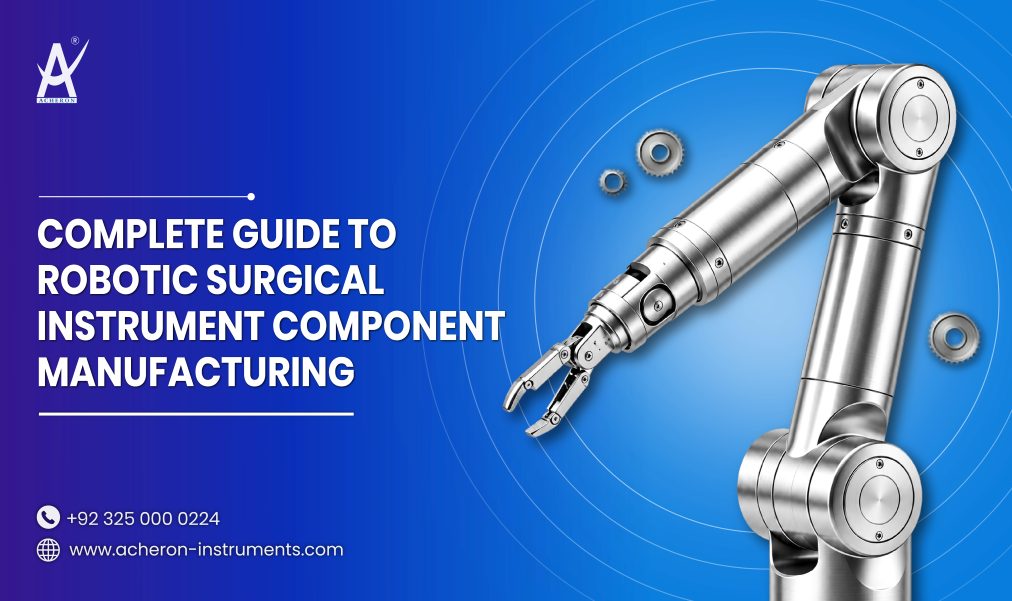
Robotic-assisted systems have transformed the way surgery is performed, with an ecosystem of components engineered to unforgiving standards behind every precise incision. This complete guide explores robotic surgical instrument component manufacturing in depth. It covers the materials involved, the machining methods used, the quality systems enforced, and the regulatory frameworks that govern the entire process. Whether you are weighing a procurement decision, evaluating a supplier, or simply seeking a clearer understanding of the field, the essentials are explained here in plain terms.
What Are Robotic Surgical Instruments?
Robotic surgical instruments are the specialized tools attached to the arms of a surgical robotic system. Unlike conventional handheld instruments, these tools are designed to articulate with additional degrees of freedom, allowing complex manipulations to be carried out through small incisions.
Because these instruments are operated remotely and often in minimally invasive settings, every internal and external component must meet an exceptional level of reliability. A single tolerance error can compromise instrument articulation, and any material failure can put a patient at risk. For this reason, the components are manufactured under conditions far more rigorous than those applied to most industrial products.
Key Components of Robotic Surgical Instruments
Before the manufacturing process is examined, the individual components should be understood. Each part is engineered to fulfill a specific mechanical or functional role, and each carries its own manufacturing challenges.
-
End effectors: The working tips, such as graspers, scissors, needle drivers, and cutting jaws, are used to manipulate tissue. Extremely tight tolerances are needed to maintain grip force and cutting precision.
-
Wrist and articulation joints: The multi-axis joints provide additional degrees of freedom. They are among the most complex components to manufacture.
-
Drive shafts and cables: The components that transmit motion from the actuator to the instrument tip. High torsional strength and fatigue resistance are essential.
-
Housings and casings: The structural enclosures that protect and align internal mechanisms.
-
Pulleys, gears, and micro-fasteners: The miniature drivetrain components by which motion is directed and controlled.
-
Electrical and sensor contacts: The conductive elements that carry power, signals, and feedback in advanced instruments.
Materials Used in Robotic Surgical Instrument Manufacturing
Material selection is considered one of the most critical decisions in the entire process. The materials must be biocompatible, corrosion-resistant, capable of withstanding repeated sterilization, and strong enough to endure mechanical stress. The following materials are most commonly relied upon:
-
Stainless Steel (Surgical Grades): Medical-grade stainless steels, especially 316L and 17-4 PH, are widely used for their corrosion resistance, strength, and machinability. They are often chosen for shafts, housings, and structural components.
-
Titanium and Titanium Alloys: Where a high strength-to-weight ratio and excellent biocompatibility are required, titanium alloys such as Ti-6Al-4V are chosen. Their fatigue resistance and non-magnetic properties make them well suited to articulating components.
-
Cobalt-Chromium Alloys: For parts that undergo heavy wear, cobalt-chromium alloys are preferred because of their exceptional hardness and wear resistance.
-
Engineering Polymers and PEEK: Certain non-structural or insulating components are made from high-performance polymers such as PEEK, which provide chemical resistance and dimensional stability while reducing weight.
-
Ceramics and Coatings: For insulation, wear resistance, or friction reduction, ceramic elements and advanced coatings, including titanium nitride and diamond-like carbon, are applied to selected surfaces.
The Robotic Surgical Instrument Manufacturing Process
The manufacturing of robotic surgical instrument components is carried out through a series of tightly controlled stages. Each stage is documented, validated, and monitored so that consistency and traceability are guaranteed.
-
Design and Engineering: During this phase, CAD models are developed, tolerances are defined, and design-for-manufacturability reviews are conducted. Prototypes are often produced and tested before full production is authorized.
-
Material Preparation and Selection: Once the designs are finalized, raw materials are sourced from certified suppliers and material certificates are verified. Traceability is then established so that every finished component can be linked back to its material batch.
-
Precision Machining: It is regarded as the heart of the process. Because features measured in microns are common, advanced machining methods are relied upon, such as CNC milling and turning, Swiss-type machining, electrical discharge machining (EDM), and micro-machining.
-
Surface Finishing and Treatment: After machining, surfaces are refined to improve performance and safety. Deburring, electropolishing, passivation, and coating are commonly applied. Passivation improves corrosion resistance, while electropolishing creates a smooth, contamination-resistant surface.
-
Cleaning and Contamination Control: The parts of the instrument are cleaned in controlled environments, often within cleanrooms, so that particulates, residues, and contaminants are removed. Cleaning protocols are validated and documented at every step.
-
Assembly and Integration: Individual components are assembled into functional instruments under controlled conditions. Micro-assembly techniques are frequently required, since many parts are too small to be handled conventionally.
-
Sterilization Validation: Although sterilization is often performed downstream, compatibility must be designed in from the outset. Materials and coatings are selected to withstand repeated autoclaving, gamma radiation, or ethylene oxide without degradation. Sterilization validation confirms safety throughout the instrument's expected lifecycle.
Why the Right Manufacturing Partner Matters
Given the precision, compliance, and consistency required, choosing a manufacturing partner is a critical decision. A capable partner should demonstrate proven expertise in medical-grade materials, advanced machining capabilities, validated quality systems, and full regulatory compliance. At Acheron Instruments, robotic surgical instrument components are manufactured with an uncompromising commitment to precision, quality, and patient safety. Advanced machining capabilities are combined with rigorous quality controls and full traceability, so components can be relied upon in the most demanding surgical environments. You can visit our website or explore our product range for more options.
Frequently Asked Questions (FAQ)
Can custom or prototype components be manufactured by Acheron Instruments?
Yes. From initial design and prototyping through to full-scale production, custom components are engineered in close collaboration with clients.
What materials are used in robotic surgical instrument components?
Medical-grade stainless steels, titanium alloys, cobalt-chromium alloys, high-performance polymers such as PEEK, and advanced ceramics and coatings are the materials most commonly used in robotic surgical instrument components.
How is quality ensured throughout the manufacturing process?
Quality is built into every stage through in-process inspection, coordinate measuring machines, optical inspection, mechanical testing, and statistical process control. Additionally, full documentation and traceability are maintained so that consistency and accountability are ensured.
Why is precision machining so important for these components?
Precision machining is important because surgical instruments operate inside the human body with minimal margin for error, ensuring that components fit, articulate, and function exactly as designed. Even small inaccuracies can compromise safety and performance.
Conclusion
Robotic surgical instrument component manufacturing sits at the intersection of advanced engineering, materials science, and uncompromising quality. From material selection and precision machining to sterilization and regulatory compliance, every stage is carried out with the care the stakes demand. When these components are trusted to guide a surgeon's hands, excellence cannot be optional.
For manufacturers, healthcare providers, and innovators alike, a clear understanding of this process is essential. And when precision, reliability, and compliance are required without compromise, a proven partner such as Acheron Instruments can be relied upon to deliver components worthy of the surgical field. Contact us today.

-1790596974.jpg)