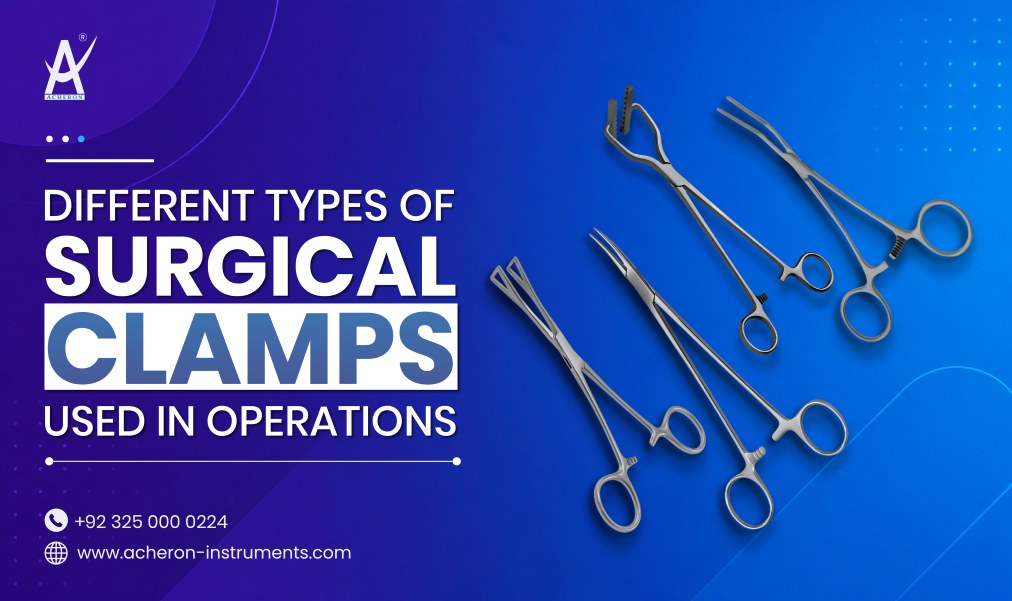
Surgical clamps are among the most important instruments used in operating rooms. They help surgeons hold tissues, control bleeding, secure drapes, occlude vessels, stabilize organs, and manage delicate anatomical structures during procedures. Moreover, different operations require different clamp designs because every tissue, vessel, bone, or surgical field has unique handling needs. In this blog, we will discuss the different types of surgical clamps used in operations, along with their uses, characteristics, and contributions to a successful surgical procedure.
What Are Surgical Clamps?
Surgical clamps are essential instruments used to hold, grasp, compress, secure, or control tissues and materials during medical procedures. They are designed to give surgeons better control within the operating field while protecting surrounding tissues from unnecessary trauma. Resembling a cross between scissors and pliers, they feature locking ratchet handles that allow surgeons to occlude vessels securely, control bleeding, and create a clear, bloodless surgical site. Furthermore, they are commonly used to:
-
Control bleeding by compressing blood vessels.
-
Temporarily occlude arteries or veins.
-
Hold tissues away from the surgical field.
-
Secure sterile towels and surgical drapes.
-
Handle delicate organs such as intestines.
-
Stabilize bone fragments during orthopedic surgery.
-
Assist in ENT, cardiovascular, gynecological, and ophthalmic procedures.
Classification of Surgical Clamps
Surgical clamps are classified according to their function, design, and area of use. The most common categories are as follows.
-
Hemostatic clamps
-
Towel clamps
-
Intestinal clamps
-
Vascular clamps
-
Bone clamps
-
Specialty surgical clamps
Each type has a specific role in surgery and is selected based on tissue type, required pressure, surgical site, and procedure complexity.
1. Hemostatic Clamps
Hemostatic clamps are used to control bleeding during surgery. They temporarily clamp blood vessels so the surgeon can ligate or repair them. These clamps are essential in general surgery, emergency surgery, trauma procedures, and many routine operations.
Uses:
- Clamp large arteries and veins to temporarily stop blood flow.
- Grasp, hold, and manipulate thick or heavy soft tissues and organs.
- Clamps off large blood vessels temporarily before a permanent suture or ligature is tied.
- Assist in performing deep abdominal or general surgery procedures.
- Crucial for rapid hemostasis during C-sections and hysterectomies.
Key Features:
- Fully serrated jaws to ensure a non-slip grip on heavy tissues and large vessels.
- Ratchet locking mechanism allows surgeons to lock the clamp at varying degrees of pressure.
- Thicker, heavier, and built to withstand the resistance of denser tissues.
- Straight and curved configurations to work on both superficial and deep surfaces.
Uses:
-
Holds dense or fibrous tissues, such as fascia, tendons, ligaments, thick muscle sheaths, etc.
-
Used as a crushing clamp on tough structural ligaments, such as the cardinal and uterosacral ligaments.
-
Clamps the umbilical cord immediately after delivery to stop blood flow.
-
Occasionally used to grip heavy structural sutures or secure heavy surgical drapes.
Key Features:
-
1×2 interlocking rat tooth tips to bite deeply into tough tissues to prevent slippage risk.
-
Transverse serrated jaws to provide an additional layer of friction and secure holding capacity.
-
Ratchet locking mechanism for hands-free pressure without requiring continuous manual force.
-
Available with either straight jaws or curved jaws to suit all needs.
Uses:
-
Clamp medium-to-large blood vessels to instantly halt blood flow.
-
Grasp and hold heavy or fatty tissues, skin, or fascia out for a clear view.
-
Used as a makeshift needle driver to hold a suture needle or to slide a tie.
-
Gently separate layers of tissue without cutting or damaging them.
Key Features:
-
Partially serrated jaws for a firm grip on vessels without completely crushing them.
-
Ratchet lock mechanism that allows the clamp to lock tightly at varying pressure levels.
-
Ergonomic finger ring handle to offer maximum stability, steering, and precision control.
-
Comes in two straight and curved profiles depending on the accessibility of the workspace.
2. Towel Clamps
Towel clamps are used to secure surgical drapes and towels around the operative site. Their purpose is to help maintain a sterile field and prevent the drapes from moving during surgery.
Uses:
-
Fasten sterile drapes and towels together and to the patient’s skin.
-
Maintains the boundaries of the sterile operative field to prevent contamination.
-
Holds tough tissues like fascia or skin folds to improve surgical exposure.
Key Features:
-
Inward curved, pointed tips to pierce through surgical drapes without slipping.
-
Multi-position ratchet allows the clamp to lock at varying degrees of tension.
-
Scissor-style finger rings to provide maximum control, comfort, and precision.
-
Boxlock joint for smooth opening and closing movements without catching.
-
Available in multiple sizes, ranging from small, lightweight options for various surgical needs.
Uses:
-
Clamps surgical drapes to one another or directly to the patient’s skin.
-
Keeps the sterile operative field boundaries intact to avoid contamination.
-
Highly preferred for delicate or small-scale operations.
Key Features:
-
Cross-Action spring handle for rapid, fluid, one-handed application and adjustment.
-
Sharp, inwardly-curved jaws to provide a secure, non-slip grip on draping materials.
-
A small profile prevents it from dragging down or bunching lightweight fabrics.
-
Angled profile to tuck neatly underneath overlying drapes, keeping the operative field clear.
Uses:
-
Maintaining the limits of the sterile surgical field by holding drapes in place.
-
Prevents fluid strike-through and maintains strict infection control.
Key Features:
-
Non-perforating, finely serrated jaws to hold the surgical drape or other materials.
-
Inwardly curved jaws to provide a secure grasping surface.
-
Flat profile allowing the instrument to rest comfortably on the patient’s body.
-
Multi-position ratchet system to lock the jaws at varying pressures.
Uses:
-
Hold sterile drapes, towels, or cloth barriers together to map out the exact boundaries.
-
Ideal for anchoring heavy ancillary equipment, including suction tubing and electrosurgical equipment.
-
Eliminates the risk of puncturing a disposable or a cloth drape.
Key Features:
-
Ergonomic finger ring handle for easy and controlled handling.
-
Rounded or flattened jaws with serrations or teeth that interlock gently, providing a secure grip.
-
Ratchet mechanism to allow the user to adjust and lock the clamping pressure.
-
Inwardly curved design to optimize edge capture on fabrics.
3. Intestinal Clamps
Intestinal clamps are used in abdominal and gastrointestinal operations. Their job is to hold or occlude parts of the intestine while minimizing trauma to delicate intestinal tissue.
Uses:
-
Temporarily clamp and close off the lumen of the small or large intestine.
-
Prevents the leakage of gastrointestinal contents into the peritoneal cavity.
-
Grasp delicate tissues, such as the intestinal walls, stomach tissue, and mucous surfaces.
-
Function as a temporary hemostat to clamp larger blood vessels and control bleeding.
-
Used in complex gynecological, cardiovascular, and general surgical interventions.
Key Features:
-
Atraumatic flexible jaws ensure that clamping pressure is distributed evenly.
-
Longitudinal or diagonal serrations to provide a secure, non-slip hold on slick mucosal surfaces.
-
Subtle, outward concave bow to gradually apply pressure along the length of the tissue.
-
Multi-position ratchet system allows self-retaining clamping action.
4. Vascular Clamps
Vascular clamps are used to control blood flow in arteries and veins. They are designed to compress vessels without causing serious damage to the vessel wall.
Uses:
-
Halting blood flow to peripheral arteries or veins to create a clean area.
-
Used in Coronary Artery Bypass Grafting (CABG), carotid endarterectomies, and aneurysm repairs to isolate specific sections of blood vessels.
-
Clamp blood supply lines to organs or vessels during an anastomosis.
-
Hold delicate tissues or secure traction sutures in place without causing damage.
Key Features:
-
Spring-loaded, cross-action mechanism to maintain steady, uniform pressure on its own.
-
Atraumatic jaws to firmly grip the vessel to prevent slippage.
-
Straight, curved, or angled variants to suit all surgical applications.
-
Compact, low-profile design for clear line of sight.
Uses:
-
Temporarily blocks or partially occludes large blood vessels, such as the aorta, inferior vena cava, and carotid artery.
-
Stabilizes and holds blood vessels in place, facilitating precise suturing.
-
Clamps vessels on either side of a blockage, keeping the surgical site dry.
-
Easily reaches into deep, confined spaces, such as the mediastinum, to secure major vessels.
Key Features:
-
Double-angled or curved jaws create a vaulted empty space around the clamped tissue.
-
Atraumatic serrations ensure a firm, non-slip grip on vessels without crushing the fragile endothelial lining.
-
An interlocking ratchet allows for a self-retaining, hands-free hold.
-
Ergonomic finger ring handle for easy and comfortable handling during surgery.
Uses:
-
Temporarily stops or restricts blood flow through targeted arteries or veins.
-
Holds vessel walls in position during anastomosis.
-
Grips vessels firmly without tearing or damaging the sensitive inner lining.
-
Navigates and reaches into deeply situated or highly confined anatomical spaces.
Key Features:
-
Atraumatic deBakey-style serrations for precise ribbing prevent vessel slippage.
-
Ratchet locking mechanism to maintain consistent, sustained pressure on its own.
-
Versatile jaw profiles to accommodate different patient sizes and difficult anatomical angles.
-
Ergonomic finger ring handle for maximum handling and control.
Uses:
-
Isolate a small section of a large vessel, such as the Aorta or the Vena Cava, for repair or modification.
-
Holds the target site still and blood-free, allowing for ultra-precise suturing.
-
Used to isolate sections of the aorta during bypass surgeries or valve replacements.
-
Crucial in liver and kidney transplants for controlling the major local veins
Key Features:
-
Unique double-angled jaws to grasp a portion of a large vessel.
-
Atraumatic serrations to provide a firm grip on slippery vessels without crushing them.
-
Partial occlusion capability to clamp a specific section of a large blood vessel.
-
Ratchet locking mechanism for self-retaining action.
5. Bone Clamps
Bone clamps are used in orthopedic surgery to hold bone fragments, plates, or fixation devices in position. They provide stability during fracture repair and bone reconstruction.
Uses:
-
Allows pulling fractured bone fragments back into their correct, natural anatomical position
-
Holds bone segments firmly in place while the surgical team applies plates, screws, or intramedullary nails.
-
Rotates or shifts bone fragments with minimal risk of slipping.
-
Ensures the bone heals straight and prevents improper unions.
Key Features:
-
Claw-like 1x2 or 2x2 pronged jaws to encircle the bone to distribute clamping pressure evenly.
-
Slender shaft profile to allow them to operate within narrow surgical windows.
-
Blunt outer edges to minimize accidental trauma or tearing of surrounding soft tissues, muscles, and blood vessels.
Uses:
-
Pull displaced bone fragments back into their natural, anatomical alignment.
-
Provides temporary fixation to hold bone grafts firmly in place while permanent hardware is installed.
-
Used in narrow or deep anatomical spaces, such as during the reduction of the posterior column.
Key Features:
-
Asymmetric semicircular jaws to wrap around the shaft of long bones.
-
Ratchet-locking or speed-lock mechanism for self-retaining action.
-
Angled/ offset profile to provide optimal mechanical leverage.
6. Specialty Surgical Clamps
Specialty surgical clamps are designed for specific surgical fields or unique operative needs. These clamps may be used in gynecology, urology, ENT, cardiovascular surgery, laparoscopic surgery, and other specialized procedures.
Uses:
-
Holding delicate organs or tissues.
-
Clamping specific anatomical structures.
-
Assisting in minimally invasive surgery.
-
Supporting complex surgical procedures.
-
Providing controlled grip in narrow or deep surgical spaces.
Key Features:
-
Procedure-specific design.
-
May have atraumatic jaws.
-
Available in various lengths and angles.
-
Designed for precision and safety.
-
Often tailored for specialized surgical access.
How Surgeons Choose the Right Clamp
Surgeons choose surgical clamps based on the type of operation, tissue involved, and level of control required. Using the wrong clamp can cause tissue trauma, poor grip, bleeding, or difficulty during the procedure. There are some important factors to consider for making this choice, which are described below.
-
Tissue type: Delicate tissues need atraumatic clamps, while tough tissues may require toothed clamps.
-
Clamp purpose: Hemostasis, tissue holding, vascular occlusion, towel fixation, or bone stabilization.
-
Jaw design: Smooth, serrated, toothed, atraumatic, straight, or curved.
-
Clamp size: The clamp must match the surgical field and tissue size.
-
Locking mechanism: Ratchet locks provide continuous grip, while spring clamps allow quick application.
-
Procedure type: General, orthopedic, vascular, gastrointestinal, or specialty surgery.
Where to Find High-Quality Surgical Clamps
Acheron Instruments is dedicated to manufacturing a wide range of surgical clamps that deliver precision, reliability, and efficiency across a broad range of surgical procedures. Our instruments are crafted from premium-grade surgical stainless steel and engineered to meet the demands of modern healthcare environments. From tissue handling and vessel clamping to specialised surgical applications, our clamps are designed to deliver consistent performance and long-term durability. Reasons to choose Surgitronix for high-quality surgical forceps include the following:
-
ISO, FDA, and CE-certified for international quality compliance
-
Manufactured using Premium German stainless steel
-
Backed by a comprehensive five-year warranty
-
Supported by a responsive 24/7 customer service
-
Competitively priced to deliver cost-effective solutions for healthcare facilities
Contact us today to learn more about product specifications, customized solutions, and bulk purchasing options tailored to meet the needs of your facility.
Conclusion
Surgical clamps are among the most important tools used in modern operations. From controlling bleeding to securing drapes, clamping intestines, managing blood vessels, stabilizing bones, and supporting specialty procedures, every clamp has a specific purpose. From hemostatic clamps to towel clamps and vascular clamps, choosing the right surgical clamp improves surgical precision, protects tissues, and supports safer outcomes in the operating room. At Acheron Instruments, we provide high-quality surgical clamps and other instruments that meet the highest standards of precision, durability, and performance required in modern medical practice. You can request a quote or visit our website for more information.

-1790596974.jpg)