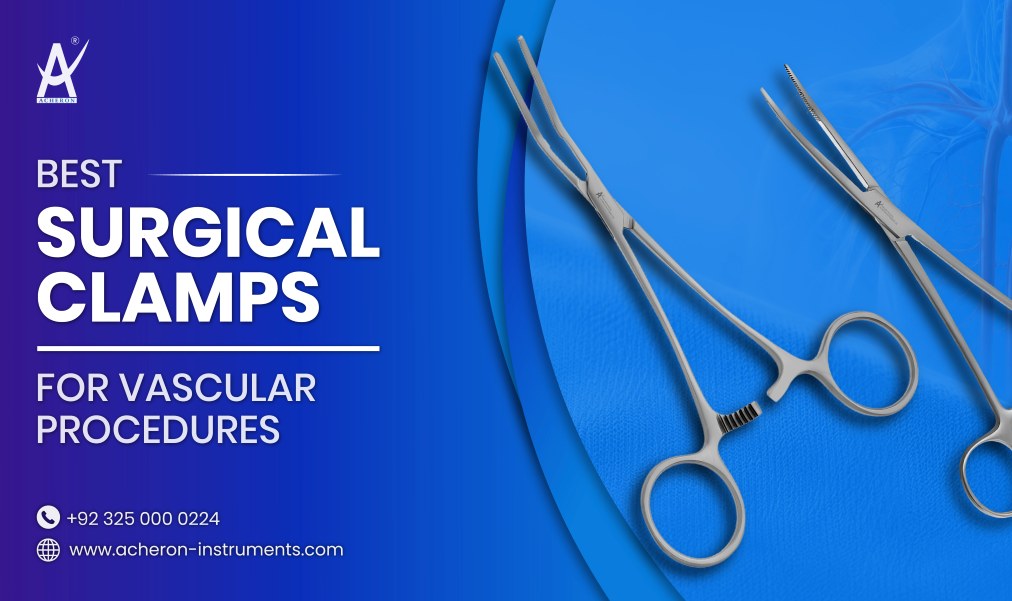
In vascular and cardiovascular surgery, controlling blood flow is not merely a procedural step but the difference between a bloodless, well-visualized surgical field and a life-threatening complication. Vascular clamps are essential instruments that enable this control, temporarily occluding arteries and veins without crushing the delicate vessel walls or damaging the endothelial lining.
However, not all clamps are created equal. The best surgical clamp for vascular procedures depends heavily on the vessel size, the anatomy being accessed, the type of occlusion required, and the need of the surgeon for precision. In this guide, we will explore the best surgical clamps for vascular procedures, their applications, key features, advantages, and the factors surgeons and healthcare facilities should consider when selecting vascular instruments.
What Are Vascular Clamps and Why Do They Matter
Vascular clamps are specialized instruments designed to temporarily control or restrict blood flow through arteries, veins, or other vascular structures during surgery. Resembling a cross between scissors and pliers, they provide the surgeon with a steady, controlled grip, while their atraumatic jaws apply just enough pressure to stop blood flow without crushing the vessel. Moreover, depending on their design, vascular clamps may provide the following benefits:
-
Complete vessel occlusion
-
Partial or tangential occlusion
-
Temporary occlusion of smaller vessels
-
Control of major arteries and veins
-
Microvascular vessel control
-
Vascular isolation during anastomosis
-
Blood-flow control during grafting or reconstruction
If you want a broader understanding of how clamping and occluding instruments fit into the surgical toolkit, Acheron Instruments' overview of the different types of surgical clamps used in operations is a helpful starting point.
Best Surgical Clamps for Vascular Procedures
DeBakey Vascular Clamps
DeBakey vascular clamps are specialized instruments used to temporarily occlude blood vessels to control hemorrhage or isolate a section of a vessel without causing crushing injuries to the delicate vascular wall.
Common Applications
-
Carotid Endarterectomy
-
Peripheral Vascular Surgery
-
Aortic Procedures
-
Vascular Reconstruction
-
Aneurysm Procedures
-
Cardiovascular Surgery
-
Vascular Bypass Procedures
Key Features
-
Atraumatic DeBakey tooth pattern
-
Straight, angled, or curved configurations
-
Available for different anatomical approaches
-
Atraumatic tangential jaws
-
Ergonomic finger ring handle
-
Multiple working end sizes
Satinsky Vascular Clamps
Satinsky vascular clamps or Satinsky vascular forceps are primarily used for partial vascular occlusion. Their distinctive scissor-like profile and doubly angled jaws allow surgeons to control or isolate a specific segment of a blood vessel without fully stopping blood flow through the rest of the vessel.
Common Applications
-
Side-to-Side & End-to-Side Vascular Anastomosis
-
Cardiac & Major Aortic Surgery
-
Renal Transplantation & Urological Surgery
-
Vena Cava & Hepatic Surgery
-
Arteriovenous (AV) Fistula Creation for Hemodialysis
Key Features
-
Double-angled jaw profile
-
Multi-position ratchet locking mechanism
-
Ergonomic finger ring handle
-
Available in different sizes and configurations
-
Atraumatic jaw surface
-
Partial occlusion shape
Cooley Vascular Clamps
Cooley vascular clamps are primarily used during cardiovascular and thoracic procedures to temporarily occlude or partially clamp blood vessels (such as the aorta, iliac, or peripheral arteries).
Common Applications
-
Aortic & Major Artery Surgery
-
Vascular Anastomosis
-
Thrombectomy & Endarterectomy
-
Pediatric Cardiac Procedures
-
Tangential / Partial Occlusion
Key Features
-
Atraumatic serrated jaws
-
Multi-step finger-ring locking mechanism
-
Curved or angled shaft designs
-
Available in different sizes and configurations
-
Ergonomic finger ring handle
Bulldog Vascular Clamps
Bulldog vascular clamps are designed to temporarily occlude coronary or peripheral arteries without crushing or damaging delicate tissue during bypass grafting or vascular reconstruction.
Common Applications
-
Vascular Surgery & Anastomosis
-
Coronary Artery Bypass Grafting (CABG)
-
Laparoscopic & Robotic Partial Nephrectomy
-
Organ Transplantation
-
Arteriovenous (AV) Fistula Creation
Key Features
-
Self-retaining spring mechanism
-
Atraumatic jaw serrations
-
Calibrated closing pressure
-
Compact, low-profile footprint
-
Variety of jaw profiles
Carotid Vascular Clamps
Carotid vascular clamps are designed to temporarily occlude or control blood flow through the carotid arteries during surgical procedures to achieve hemostasis while minimizing trauma to delicate vessel walls and preventing arterial injury or intimal tearing that could trigger plaque embolization.
Common Applications
-
Carotid Endarterectomy (CEA)
-
Transcarotid Artery Revascularization (TCAR)
-
Carotid Artery Aneurysm Repair
-
Carotid-Subclavian & Carotid-Axillary Bypass
-
Trauma & Penetrating Neck Injuries
-
Extracranial-to-Intracranial (EC-IC) Bypass
Key Features
-
Atraumatic DeBakey serrations
-
Calibrated ratchet locking mechanism
-
Angled, curved, or offset jaw profiles
-
Circular or ring-tipped clamp ends
-
Self-retaining spring mechanism
Harken Vascular Clamp
Harken vascular clamp is a specialized instrument designed for the temporary occlusion and atraumatic manipulation of major blood vessels, such as the aorta, vena cava, or pulmonary arteries, during open-chest and vascular surgical procedures.
Common Applications
-
Cardiothoracic Surgery
-
Vascular Surgery
-
Transplant Surgery
-
Trauma Surgery
Key Features
-
Interlocking DeBakey serrations
-
Ergonomic finger ring handle
-
Multistage ratchet-lock mechanism
-
Slender, elongated shanks
-
Distinct curved jaw profile
Vascular Clamp Comparison
|
Clamp Type |
Primary Function |
Typical Application |
|
Debakey Clamp |
Controlled vascular occlusion |
Aortic and peripheral vascular surgery |
|
Satinsky Clamp |
Partial/tangential occlusion |
Major vessels and anastomosis |
|
Cooley Clamp |
Vascular occlusion |
Cardiovascular and major-vessel procedures |
|
Bulldog Clamp |
Temporary local occlusion |
Small vessels |
|
Carotid Clamp |
Carotid vessel control |
Carotid procedures |
|
Harken Clamp |
Vessel control and occlusion |
Vascular and cardiovascular procedures |
Vascular Clamp Maintenance and Inspection
For reusable surgical instruments, proper inspection and maintenance are essential to ensure performance. Before use, healthcare facilities should follow their established protocols and the applicable manufacturer's instructions for use. Inspection may include checking:
-
Jaw alignment
-
Jaw surface integrity
-
Ratchet function
-
Joint movement
-
Spring action
-
Corrosion or staining
-
Surface damage
-
Loose components
-
Proper opening and closing
-
Overall structural condition
Vascular clamps have fine working surfaces that can be damaged by improper handling. Instrument-processing guidance emphasizes that delicate vascular jaw inserts should be visually inspected rather than tested by clamping against hard objects.
Why Choose Acheron Instruments for High-Quality Vascular Clamps
The performance and longevity of a vascular clamp depend on its construction. High-grade surgical stainless steel resists corrosion through repeated sterilization cycles and maintains its precise jaw alignment over years of use. At Acheron Instruments, we manufacture our clamps from premium German and U.S. surgical-grade stainless steel, with ISO-certified quality control and warranties exceeding five years, the kind of durability that matters in high-stakes procedures. You can explore Acheron Instruments' full range of CVT surgical instruments for cardiovascular and thoracic procedures, or browse the complete clamp-type instrument collection to find the exact patterns and sizes your procedures demand.
Conclusion
Choosing the best surgical clamp for a vascular procedure involves balancing vessel size, occlusion requirements, anatomical reach, and instrument quality. From a bulldog clamp to a Harken vascular clamp, each instrument type helps medical professionals excel in vascular surgery and achieve optimal patient recovery. Whatever the procedure, the underlying requirement is the same: an atraumatic, precisely engineered, corrosion-resistant instrument you can trust. At Acheron Instruments, every vascular clamp is crafted to meet the highest standards of precision, durability, and surgical performance. Request a quote or download the catalog to equip your surgical team with reliable vascular control. Contact us today for more information.

-1790596974.jpg)