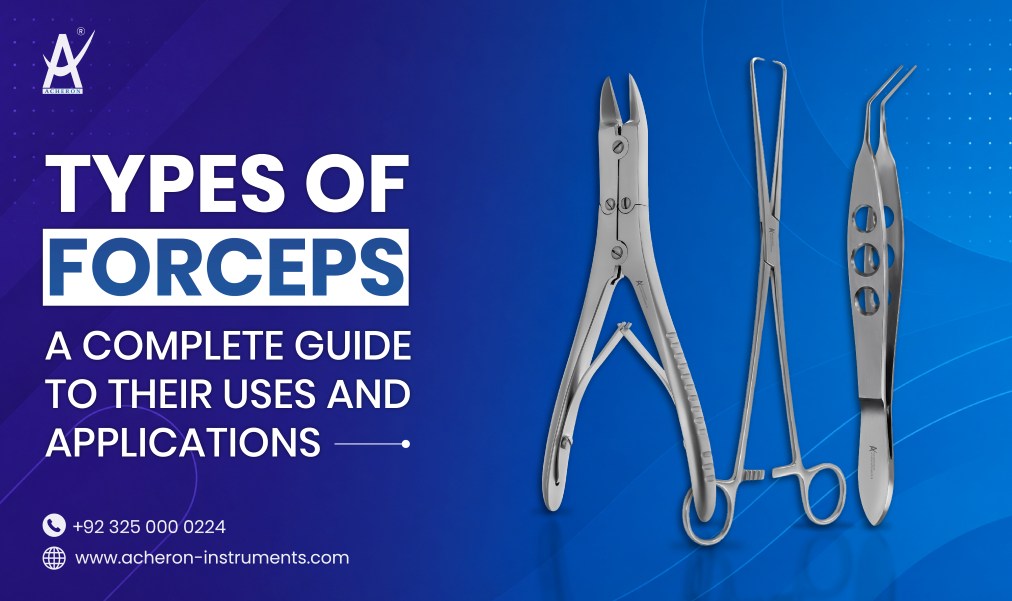
Surgical instruments play a critical role in ensuring precision and efficiency during surgical procedures. Among these instruments, different types of forceps are considered essential tools in almost every medical specialty. From grasping delicate tissues to controlling bleeding and handling dressings, forceps provide surgeons and healthcare professionals with better control during procedures. Furthermore, forceps come in various designs, shapes, and sizes, each intended for specific surgical applications. This guide explores the different types of forceps, their classifications, and their uses in surgical procedures.
What Are Surgical Forceps?
Forceps are handheld medical instruments designed to grasp, hold, manipulate, compress, or extract tissues and objects during various surgical procedures. They function similarly to tweezers or pincers and are manufactured with varying jaw designs depending on their intended purpose. Different types of surgical forceps are used across several surgeries, including:
-
General surgery
-
Orthopedic surgery
-
Neurosurgery
-
Gynecology
-
Obstetrics
-
Dental procedures
-
Plastic surgery
-
Microsurgery
-
Veterinary procedures
Moreover, the design of forceps allows healthcare professionals to handle tissues with controlled pressure and enhanced precision. Forceps are broadly divided into two main categories: non-locking and locking. Their simple design offers greater tactile sensitivity, allowing surgeons to feel the pressure applied to tissues. Furthermore, common forceps uses include the following:
-
Grasping tissues during surgery
-
Holding surgical materials
-
Controlling bleeding
-
Removing foreign objects
-
Handling dressings and sutures
-
Extracting teeth or tissues
-
Assisting during delicate procedures
How Are Forceps Classified?
Understanding the various types of forceps starts with three classification frameworks:
-
By Function: Forceps are designed to grasp, hold, clamp, or dissect. Each function requires a different jaw shape, tip profile, and grip mechanism.
-
By Design: Instrument forceps fall into two broad design categories, locking (ratcheted, like hemostats) and non-locking (spring-tension, like surgical pickups). Jaw surfaces may be toothed for a secure grip or smooth to minimize tissue trauma.
-
By Application: Surgical forceps, hemostatic forceps, thumb forceps, and dressing forceps each serve distinct practice environments with their own sterilization and handling requirements.
Major Categories & Types of Surgical Forceps
Forceps surgical instruments are broadly classified by their function. Below is a breakdown of the most important categories and the specific types within each.
Tissue Forceps
Tissue forceps are used to grasp, hold, and manipulate soft tissue during surgery. They are among the most commonly used surgical tools and come in several distinct designs.
-
Allis Forceps: Feature interlocking teeth that grip tissue securely without slipping. Commonly used in gastrointestinal and gynecological surgeries.
-
Babcock Forceps: Have a rounded, fenestrated (windowed) tip for grasping delicate organs like the intestine or fallopian tube without crushing them.
-
Kocher Forceps: Also called toothed tissue forceps, these have heavy interlocking teeth at the tip and are used on tough or fibrous tissue.
-
Duval Forceps: Triangular-tipped forceps designed for grasping lung tissue or other fragile structures without causing trauma.
Hemostatic Forceps
Hemostatic forceps are clamping instruments used to compress blood vessels and control bleeding, a critical function in nearly every type of forceps surgery. They typically have a ratcheted locking mechanism.
-
Kelly Forceps: Partially serrated jaws used for clamping blood vessels and tissue in general surgery.
-
Halsted Mosquito Forceps: Smaller, more delicate versions of Kelly forceps, ideal for clamping fine blood vessels in superficial procedures.
-
Rochester-Ochsner Forceps: Heavy-duty hemostatic forceps with fully serrated jaws and teeth, used to clamp large vessels or thick tissue.
-
Crile Forceps: Similar to Kelly forceps but with fully serrated jaws; widely used in abdominal and thoracic surgeries.
-
Mixter Forceps: Right-angled forceps used to pass ligatures around vessels or structures in confined spaces.
Thumb Forceps
Thumb forceps, also called surgical pickups or pickups forceps, are non-locking, spring-action instruments operated by squeezing between the thumb and fingers. They are used to pick up surgical instruments, such as those for fine tissue handling, suturing assistance, and wound closure.
-
Plain Thumb Forceps: Used to handle delicate structures, such as the peritoneum or blood vessels, where teeth could cause injury.
-
Toothed Thumb Forceps: Feature small interlocking teeth at the tip for a firmer grip on skin and fascia during suturing.
-
Gerald Forceps: Delicate, bayonet-shaped thumb forceps used in neurosurgical and cardiovascular procedures.
-
DeBakey Forceps: Feature a unique longitudinal serration pattern that grips tissue firmly without crushing, widely used in vascular surgery.
Dressing Forceps
Dressing forceps are non-toothed instruments primarily used to apply and remove wound dressings, pack wounds, and handle sterile gauze or swabs.
-
Spencer Wells Forceps: Used in wound care to hold dressings or insert packing material.
-
Cheatle Forceps: Long-handled forceps used to retrieve sterile instruments from sterilization containers without contaminating them.
-
Tilley’s Dressing Forceps: Angled forceps commonly used in ENT procedures for nasal packing.
Obstetric Forceps
Obstetric forceps are curved, spoon-shaped instruments placed around a baby’s head to assist delivery when labor stalls or the baby is in distress. Their design is unique among surgical forceps, featuring large, curved blades that cradle the fetal head without causing harmful compression.
-
Simpson Forceps: The most commonly used obstetric forceps, featuring a pronounced cephalic curve and a gentler pelvic curve for outlet and low deliveries.
-
Kielland Forceps: Have a minimal pelvic curve and a sliding lock mechanism, making them suitable for rotating a baby in an unfavorable position.
-
Wrigley Forceps: Short, lightweight forceps designed for deliveries when the baby’s head is already low in the pelvis, often used in cesarean sections.
Ligating Forceps
Ligating forceps are designed to hold sutures or ties in place around vessels, ducts, or tissue during ligation procedures.
-
Lahey Forceps: Right-angled ligating forceps are frequently used in thyroid surgery to isolate and ligate the thyroid vessels.
-
Adson Forceps (Ligating Type): Fine-tipped forceps used to grasp and hold delicate suture material during vessel ligation.
-
Rochester-Pean Forceps: Used to clamp and ligate large vessels or pedicles in major abdominal surgeries.
Microsurgical Forceps
Microsurgical forceps are ultra-fine, precision-engineered instrument forceps used under microscopic magnification. They are essential in procedures that require millimeter-level accuracy.
-
Jeweler’s Forceps: Extremely fine-tipped forceps borrowed from watchmaking; used to handle microscopic sutures and tissue.
-
Castroviejo Forceps: Designed for ophthalmic surgery, used to grasp the conjunctiva, cornea, and other ocular structures.
-
Micro Bipolar Forceps: Combine a grasping function with electrosurgical coagulation capability—common in neurosurgery and microsurgery.
-
Colibri Forceps: Short, fine-tipped forceps used in corneal and anterior segment eye surgery.
How to Choose the Right Forceps
Selecting the proper forceps depends on several factors:
-
Procedure Type: Different surgeries require different instruments.
-
Tissue Characteristics: Delicate tissue requires smooth forceps, while tougher tissues may require toothed instruments.
-
Grip Design: Proper grip improves control and reduces fatigue.
-
Size and Shape: The length and jaw configuration should match procedural requirements.
Where to Find High-Quality Sugical Forceps
Acheron Instruments manufactures high-quality surgical forceps designed to meet the demanding requirements of modern medical procedures. Hospitals, clinics, surgical centers, and healthcare facilities depend on precision-engineered forceps that deliver superior performance, reliability, and long-term durability. Acheron Instruments has built a reputation as a trusted provider of Premium surgical solutions by prioritizing quality, innovation, and customer satisfaction.
Healthcare professionals choose Acheron Instruments for surgical forceps and related medical instruments for several important reasons:
-
ISO, FDA, and CE-certified for international quality compliance.
-
Manufactured from Premium German stainless steel for exceptional durability.
-
Engineered with precision for enhanced control and surgical accuracy.
-
Protected by a comprehensive five-year warranty.
-
Supported by dedicated 24/7 customer assistance.
-
Competitively priced to provide cost-effective solutions for growing healthcare facilities.
Contact us today to learn more about product specifications, customized manufacturing options, and bulk purchasing solutions designed to meet the specific needs of your healthcare facility.
Conclusion
Forceps remain among the most essential tools in modern medicine. Their diverse designs enable healthcare professionals to perform procedures with precision, safety, and efficiency. Whether used for tissue handling, controlling bleeding, assisting childbirth, or performing delicate microsurgery, selecting the right forceps significantly impacts surgical outcomes.
Understanding the various categories and types of surgical forceps helps medical professionals choose the most suitable instrument for each procedure. At Acheron Instruments, we provide a wide range of forceps to meet the increasing demands for precision and patient safety. Visit our website today for more information.

-1790596974.jpg)