In dental surgery procedures, visibility is crucial to perform precise and safe treatment. Whether you're placing a lower molar restoration, performing a surgical extraction, or completing an orthodontic procedure, the tongue and cheek are constantly competing for space in an already tight working area. That is where dental retractors come in, and two names come up more than almost any others: the sweetheart retractor and the tongue retractor.
If you have ever wondered whether these are two completely different instruments or just two names for the same tool, you are not alone. In this guide, we'll explain exactly how sweetheart and tongue retractors differ in design and use, so you can choose and use the right instrument with confidence.
What is a Tongue Retractor?
A tongue retractor is a dental or surgical instrument used to depress, deflect, or hold the tongue away from the treatment site. Its main purpose is to provide a clear view of the mouth or throat and create enough working space for examination, treatment, or surgery. Because the tongue is muscular, mobile, and highly sensitive, retracting it safely and comfortably is a design challenge. Over the decades, several distinct tongue retractor styles have emerged, including the following:
-
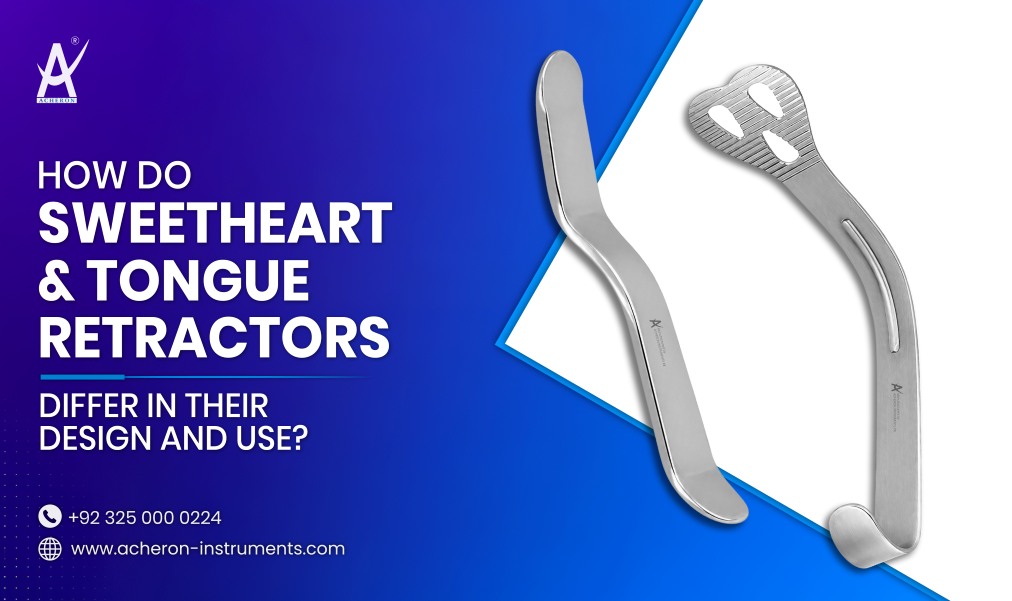
Weider (Sweetheart) retractors: Curved, fenestrated, heart-shaped blade.
-
Lack's tongue depressor: A flatter, angled blade historically used for straightforward tongue displacement.
-
Rowe's lingual retractor: Used primarily in maxillofacial and reconstructive procedures.
-
Ribbon or malleable strip retractors: Flexible stainless steel or copper strips bent to a custom shape for the specific case.
-
Dingman-style retractors: Self-retaining frames with interchangeable tongue depressor blades, used in dental, ENT, and maxillofacial cases.
How Does a Tongue Retractor Work?
The working end is positioned against an appropriate surface of the tongue. The clinician then applies gentle, controlled pressure to move the tongue away from the operative site. For example, if a dentist needs access to the inside surface of the lower teeth, the tongue can be retracted toward the opposite side. If surgery involves the floor of the mouth or posterior oral cavity, the tongue may be moved upward, forward, or laterally depending on the procedure.
What Is a Sweetheart Retractor?
The sweetheart retractor gets its name from the shape of its working end, with a curved, symmetrical blade that resembles a heart when viewed head-on. In dentistry and oral surgery, the term usually refers to the Weider Sweetheart Retractor, which is used to gently hold the tongue, cheek, lips, and other soft tissues away from the operative area so the clinician has better visibility and access. Moreover, what sets the sweetheart retractor apart from generic tongue retractors is a combination of purposeful design features, which include the following:
-
Heart-Shaped, Curved Blade: Contours naturally to the mandible and the base of the tongue.
-
Serrated or textured working surface: Grips the tongue's mucosa gently to prevent slipping, without causing trauma.
-
Fenestrations (Openings) in the Blade: Allow a suction tip to pass through the retractor itself, keeping the field clear of saliva and fluids.
-
Rounded Margins: Distribute pressure evenly across soft tissue, reducing patient discomfort during longer procedures.
-
Ergonomic, Curved Handle: Designed to rest comfortably in the clinician's hand, reducing grip fatigue during extended use.
-
Dual Functionality: Many sweetheart retractors can retract the cheek and lip in addition to the tongue, making them a versatile single-instrument solution.
Furthermore, this same design philosophy, which includes contoured blades, rounded atraumatic edges, and ergonomic handles, is applied by precision manufacturers like Acheron Instruments across their broader retractor line, including instruments such as the Minnesota Cheek Retractor and the Bauer Intraoral Retractor, both built for the same kind of controlled, atraumatic soft-tissue retraction.
Sweetheart vs. Tongue Retractor: Design Differences
|
Feature |
Generic Tongue Retractor |
Sweetheart (Weider) Retractor |
|
Blade shape |
Flat, angled, or straight, depending on style |
Curved, heart-shaped, contoured to the jaw |
|
Working surface |
Smooth or minimally textured |
Serrated/textured for a secure, atraumatic grip |
|
Suction compatibility |
Rarely built in |
Fenestrated blade allows suction tube passage |
|
Versatility |
Often single-purpose (tongue only) |
Frequently doubles for cheek and lip retraction |
|
Handle design |
Basic, straight handle |
Curved, ergonomic handle for reduced fatigue |
|
Common material |
Stainless steel (varies by style) |
Surgical-grade stainless steel, autoclavable |
|
Typical sizing |
Varies by manufacturer |
Usually offered in 2–3 head sizes |
How Their Uses Differ in Clinical Practice
When a General Tongue Retractor Is Used
Basic or specialty tongue retractors, such as Lack's depressor or malleable strip retractors, are often chosen when:
-
A simple, momentary displacement of the tongue is needed for a quick procedure.
-
The clinician needs a custom-bendable instrument for an unusual anatomical situation.
-
Cost or simplicity is prioritized over added features like suction access.
When a Sweetheart Retractor Is Preferred
The sweetheart/Weider retractor is often the preferred choice for more involved procedures because it offers added functionality:
-
Lower molar and mandibular procedures: Its curved blade is specifically shaped to follow the contour of the lower jaw, making it ideal for surgical extractions and restorations in this region.
-
Procedures requiring suction management: The fenestrated blade allows clinicians to pass a suction tip through the instrument itself, keeping the field visible without a second retraction step.
-
Longer procedures: The serrated grip and ergonomic handle reduce the need for frequent repositioning, improving both patient comfort and clinician efficiency.
-
Multi-tissue retraction: When both the tongue and cheek need to be held back, a single sweetheart retractor can often do the job of two separate instruments.
Sourcing Sweetheart and Tongue Retractors from a Trusted Manufacturer
Instrument quality has a direct impact on patient comfort and procedural efficiency, so where you source your retractors matters just as much as which design you choose. Acheron Instruments is an ISO-certified manufacturer producing surgical-grade retractors and dental instruments from German and US stainless steel, with a wide retractor catalog spanning dental, ENT, and maxillofacial applications. We also accommodate custom and private-label manufacturing, so if your practice or distribution catalog specifically needs a sweetheart-style, Weider-pattern retractor, you can request a quote directly with your exact specifications.
Furthermore, within our range of Dental Surgery Instruments, we offer closely related, purpose-built retractors that follow the same contoured, atraumatic design principles as the sweetheart retractor, including:
-
Dingman Retractor: A self-retaining frame with interchangeable tongue depressor blades for tongue and cheek retraction.
-
Minnesota Cheek Retractor: Blunt-edged, bayonet-shaped design for cheek, lip, and tongue retraction.
-
Bauer Intraoral Retractor: Curved, concave blade for retracting the masseter and cheek during intraoral mandibular procedures.
-
Sigmoid Retractor: Curved blade designed for mandibular notch retraction.
-
Tongue Depressor: Double-ended, angled blades for atraumatic tongue displacement during exams and minor procedures.
Conclusion
The main difference between a sweetheart retractor and a general tongue retractor is specialization. A tongue retractor is a broad category of instruments designed to move or stabilize the tongue, whereas the sweetheart retractor, commonly associated with the Weider pattern, is a specific tongue retractor distinguished by its curved, heart-shaped working end. Moreover, for dental professionals, oral surgeons, hospitals, and instrument distributors, the appropriate choice should therefore be based on the intended clinical application rather than the instrument name alone.
If you are sourcing dental or surgical retractors for your practice or distribution business, Acheron Instruments offers a broad selection of precision-manufactured retraction instruments. Explore the full retractor catalog from Acheron Instruments or contact us to outfit your practice with dependable, surgical-grade dental retractors.

-1790596974.jpg)