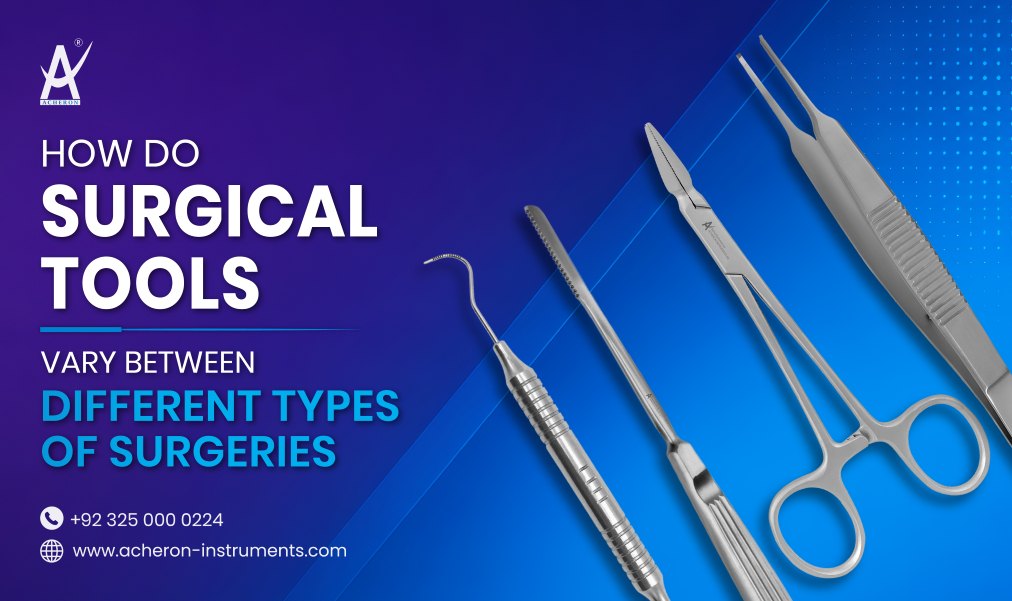
Surgical tools vary significantly across different types of surgery because each operation involves distinct organs, tissues, risks, access points, and levels of precision. A scalpel used to open skin for a general surgeon looks nothing like the micro-scissors a neurosurgeon uses under a microscope, and the bone-cutting saws in an orthopedic tray would be useless, even dangerous, in a delicate eye procedure. Understanding how surgical tools vary between different types of surgery helps healthcare professionals select the right tools, improve surgical efficiency, and support patient safety. In this blog, we will break down surgical instrumentation by speciality, explain why each speciality demands its own toolkit, and highlight the key differences that set one surgical tray apart from another.
Why Surgical Tools Differ Across Specialities
Surgical instruments are selected according to the needs of a particular operation. Before delving into specific categories, it helps to understand the core factors that drive instrument design:
-
Tissue Type: Cutting through bone requires a completely different technique than cutting through soft tissue, nerves, or blood vessels.
-
Precision Requirements: Neurosurgery and ophthalmic surgery demand micro-scale accuracy, while general and orthopedic surgery often prioritize strength and leverage.
-
Access and Visibility: Open surgery, laparoscopic surgery, and robotic surgery each require instruments of different shapes and sizes to reach the surgical site.
-
Speed vs Delicacy: Trauma and emergency surgery often favor tools designed for rapid access, while elective microsurgery favors slow, controlled precision.
-
Risk of Complications: Instruments used near critical structures (brain, heart, spinal cord) are engineered with extra safeguards to minimize accidental injury.
With that framework in mind, let's explore how these principles play out across major surgical specialities.
1. General Surgery Instruments
General surgery includes a wide range of procedures, from appendectomies and hernia repairs to gallbladder removal and more, which is why its toolkit is often seen as the foundation of surgical instrumentation. The general surgery instruments used in this speciality must be versatile enough to handle both routine and more complex operations. Common general surgery tools include the following:
-
Scalpels and disposable blades for initial incisions.
-
Metzenbaum and Mayo scissors for tissue and suture cutting.
-
Hemostatic forceps (Mosquito, Kelly, Crile) to clamp bleeding vessels.
-
Tissue forceps and Allis clamps for handling and retracting tissue.
-
Needle holders for suturing.
-
Retractors (Army-Navy, Richardson) to hold incisions open.
These instruments are designed for versatility rather than extreme specialization, since general surgeons work across many organ systems and tissue types, sometimes within a single operation.
2. Orthopedic Surgery Instruments
Orthopedic surgery focuses on bones, joints, and connective tissue, so its instruments are designed for strength, torque, and structural precision rather than the fine dexterity required in soft-tissue specialities. The following are common orthopedic surgery instruments:
-
Bone saws (oscillating and reciprocating) for cutting bone.
-
Drills and power tools for inserting screws, pins, and plates.
-
Osteotomes and chisels for shaping bone.
-
Bone curettes for scraping and cleaning bone surfaces.
-
Rongeurs for gripping and removing small bone fragments.
-
Orthopedic mallets and bone hooks.
-
Joint-specific implants and prosthetic-fitting instruments (for hip and knee replacements).
Because orthopedic procedures often involve implants, screws, rods, and joint replacements, this speciality relies heavily on measurement and calibration tools, such as depth gauges and alignment guides, which are rarely needed in soft-tissue surgery.
3. Cardiovascular and Cardiac Surgery Instruments
Cardiac and vascular surgery instruments must handle delicate blood vessels and a beating (or arrested) heart, often under extreme time pressure. Many CVT surgical instruments are designed to enable rapid, secure vessel occlusion, since even seconds of restricted blood flow can matter. Distinctive cardiac or CVT surgery tools include the following:
-
Sternal saws for opening the chest cavity.
-
Rib spreaders (sternal retractors) to maintain access.
-
Vascular clamps (Satinsky, DeBakey) to control blood flow without damaging vessel walls.
-
Coronary artery bypass tools, including specialized scissors and forceps for suturing tiny vessels.
-
Cardiopulmonary bypass (heart-lung machine) cannulas.
-
Valve-specific instruments for repairing or replacing heart valves.
4. Neurosurgical Instruments
Neurosurgery works on some of the most delicate tissue in the body, so its instruments are extremely fine, often used under a microscope, and designed to minimize even microscopic trauma. The following are common neurosurgical instruments:
-
Craniotomy tools such as bone flap elevators and cranial drills.
-
Micro-scissors and micro-forceps for handling nerves and blood vessels.
-
Bipolar forceps for precise, localized cauterization.
-
Dural hooks and dissectors for opening the protective membrane around the brain.
-
Nerve stimulators to identify and protect critical nerve pathways.
-
Stereotactic frames and neuronavigation probes for image-guided precision.
5. Ophthalmic Surgery Instruments
Ophthalmic surgery may involve the smallest and most delicate instruments, designed for procedures on structures just millimetres in size. These instruments are lightweight and have very small working tips. They must allow controlled movements inside a limited operating space. Common ophthalmic surgery instruments include the following:
-
Eye specula to keep the eyelids open.
-
Micro-scalpels and diamond knives for corneal incisions.
-
Capsulorhexis forceps for cataract surgery.
-
Phacoemulsification probes to break up and remove cataracts.
-
Micro-needle holders for suturing the cornea or sclera.
-
Vitrectomy instruments for retinal procedures.
6. ENT (Ear, Nose, and Throat) Surgery Instruments
ENT surgery blends fine dexterity with instruments designed for narrow, hard-to-access anatomical spaces. Many ENT procedures now rely on endoscopic and image-guided systems, blurring the line between traditional tools and minimally invasive technology. Common ENT surgery instruments include the following:
-
Nasal specula for examining and operating within the nasal cavity.
-
Endoscopes for sinus surgery.
-
Micro-forceps and curettes for ear procedures.
-
Tonsil and adenoid instruments (snares, dissectors).
-
Laryngoscopes for airway and throat visualization.
7. Minimally Invasive and Laparoscopic Surgery Instruments
Minimally invasive surgery (MIS) has transformed instrument design, requiring tools that operate through tiny incisions rather than large open cavities. Unlike open surgery tools, laparoscopic instruments must be long enough to reach internal structures through small ports while allowing precise, controlled movement from outside the body, a major engineering challenge compared with traditional handheld tools. The following are typical instruments used in minimally invasive and laparoscopic surgery.
-
Trocars to create and maintain access ports.
-
Laparoscopic scissors, graspers, and dissectors.
-
Laparoscopes (cameras) for visualization.
-
Clip appliers and staplers for sealing vessels or tissue.
-
Insufflation needles to create working space with gas (usually CO2).
8. Dental and Oral Surgery Instruments
Oral and maxillofacial surgery instruments are designed for use within the small, densely packed space of the mouth and jaw. The following are common dental surgery instruments:
-
Elevators and forceps for tooth extraction.
-
Periosteal elevators for separating gum tissue from bone.
-
Surgical burs and handpieces for cutting bone or teeth.
-
Bone rongeurs and curettes for jaw surgery.
-
Suturing instruments designed for oral tissue.
9. Plastic and Reconstructive Surgery Instruments
Plastic surgery instruments prioritize precision handling of skin and soft tissue to minimize scarring and achieve fine cosmetic or reconstructive outcomes. Typical plastic and reconstructive surgery instruments include the following:
-
Fine-tipped scissors (such as iris scissors) for detailed tissue work.
-
Skin hooks and fine forceps for atraumatic tissue handling.
-
Dermatomes for harvesting skin grafts.
-
Liposuction cannulas for body contouring procedures.
-
Microsurgical instruments for flap reconstruction and microvascular surgery.
Surgical Tool Comparison by Speciality
|
Surgery Type |
Primary Tool Focus |
Scale of Precision |
|
General Surgery |
Cutting, clamping, suturing |
Moderate |
|
Orthopedic Surgery |
Bone-cutting, drilling, implant placement |
Structural/mechanical |
|
CVT Surgery |
Vascular clamping, rapid access |
High, time-sensitive |
|
Neurosurgery |
Micro-dissection, nerve preservation |
Extremely high (millimetre-scale) |
|
Ophthalmic Surgery |
Micro-incision, tissue-sparing |
Extremely high (micron-scale) |
|
ENT Surgery |
Endoscopic access, narrow spaces |
High |
|
Laparoscopic Surgery |
Long-shaft instruments through small ports |
High |
|
Dental Surgery |
Bone and soft tissue work in confined space |
Moderate to high |
|
Plastic Surgery |
Atraumatic soft-tissue handling |
High (cosmetic precision) |
Why Choose Acheron Instruments for Surgical Tools?
Acheron Instruments is a surgical instrument manufacturer based in Sialkot, Pakistan, a region internationally recognized for surgical instrument production. We provide individual instruments and procedure-specific sets across general surgery, dental, orthopedic, ophthalmic, ENT, and other specialized categories. Additionally, medical practices, hospitals, importers, and distributors can consider Acheron Instruments for:
-
A broad selection of surgical instruments
-
Premium-grade stainless-steel options
-
General and specialty instrument categories
-
Individual instruments and complete surgical sets
-
Structured product inspection
-
International quality and regulatory documentation
-
Product guidance for different clinical applications
-
Support for professional and institutional purchasing
Conclusion
Surgical tools vary between different types of surgery because every speciality has unique demands relating to anatomy, tissue type, access, force, visibility, and precision. General surgery relies on versatile instruments for cutting, clamping, retracting, and suturing, while orthopedic surgery requires durable tools for drilling, shaping, and stabilizing bone. CVT surgery relies on delicate vascular clamps and rapid-access instruments, whereas neurosurgical and ophthalmic procedures require extremely precise microsurgical tools. ENT, dental, plastic, and laparoscopic surgeries also use specially shaped instruments designed for narrow spaces, delicate tissues, or minimally invasive access.
Moreover, selecting the correct surgical instruments is essential for improving accuracy, reducing tissue damage, controlling bleeding, and supporting an efficient surgical workflow. At Acheron Instruments, we provide high-quality surgical instruments designed to meet the diverse requirements of healthcare professionals, hospitals, clinics, and medical distributors. Explore our range of surgical instruments or contact our team today to discuss your product requirements, request a quotation, or learn more about our surgical instrument solutions.

-1790596974.jpg)