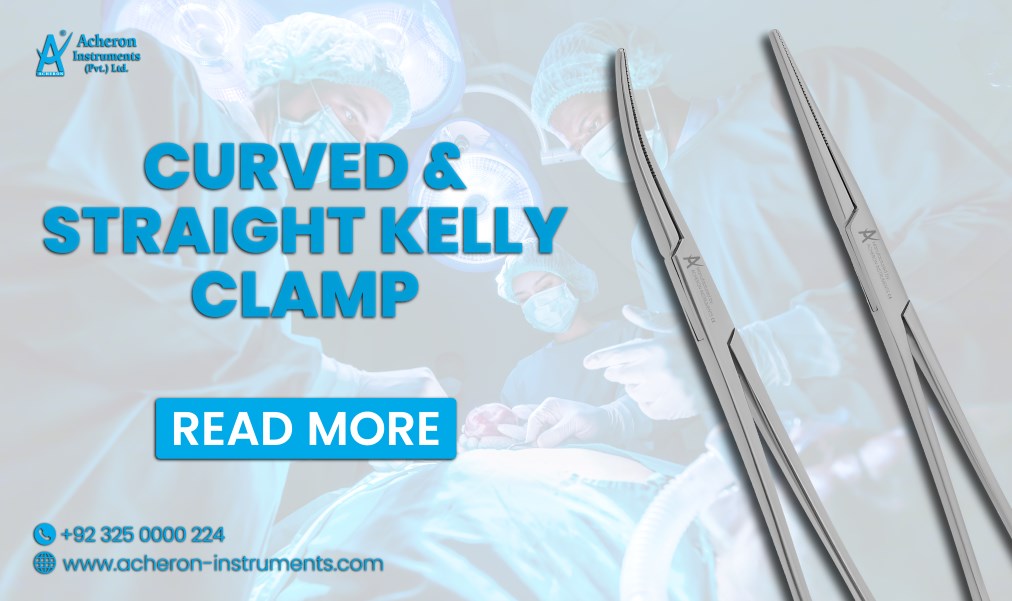
When it comes to surgical instruments, even slight variations can impact procedural effectiveness. One of the most commonly used tools in medical settings is the Kelly clamp, which surgeons rely on to control bleeding and is available in different forms. Each variant serves specific purposes. In this blog, we will discuss the key differences between curved and straight Kelly clamps to help you make informed choices for different surgical scenarios.
Curved and Straight Kely Clamp: Key Differences
Shape/design
The major difference lies in the shape of the jaw:
- Straight Kelly Clamp has a linear design, best suited for straightforward access.
- A curved Kelly clamp features a bend near the tip, enabling easier access to deeper surgical sites.
Precision and visibility
- A straight Kelly clamp works more effectively for visible, external structures and provides a direct line of sight in superficial areas.
- Curved Kelly clamps enhance tip visibility, particularly in deep or less accessible surgical spaces.
Access to surgical areas
- Straight Kelly clamps are suited for tasks where surface access is direct and unobstructed.
- Curved Kelly clamps are preferable for deeper or more confined areas, such as underlying tissues or body cavities.
Manueverability
- Straight Kelly clamps are less versatile in tight or angled environments due to their rigid, linear profile.
- Curved Kelly clamps offer greater maneuverability and flexibility when working around organs or vessels.
Applications
Straight Kelly clamps are primarily used in:
- Clamping superficial vessels or tissues that are readily accessible or closer to the surface.
- Serving as a general-purpose tool in surface-level procedures.
- Securing sutures or surgical materials, such as towels or drapes, during procedures.
Curved Kelly clamps are mainly used in:
- Clamping blood vessels in deep cavities—such as thoracic, abdominal, or pelvic cavities—particularly when a direct line of sight is limited.
- Navigating around anatomical or confined areas.
- Assisting with blunt tissue dissection around the gallbladder.
Curved and Straight Kelly Clamp: A Quick Comparison
Here is a quick comparison table for the major differences between the two variants:
|
Features |
Straight Kelly Clamp |
Curved Kelly Clamp |
|
Shape |
Straight, jaw, and handle aligned |
Angled, jaw offset from the handle axis |
|
Best use |
Superficial areas, including skin, fascia, and vessels |
deep or confined areas such as retroperitoneal spaces, curved anatomical spaces |
|
Primary function |
Grasps superficial tissues, clamps blood vessels, and holds needles |
Blunt tissue dissection and deep vessel clamping |
|
Visibility |
Direct line of sight obstructs the tip view in deep areas |
Better tip visibility in confined areas |
|
Manueverability |
Less flexible in tight or confined areas |
Easier to navigate around anatomical spaces |
|
Length |
Available in multiple lengths, typically shorter |
Available in similar lengths, typically with more curvature |
Want to know the difference between a Kelly clamp and a hemostat? Here’s your guide!
Advantages and Disadvantages of Straight and Curved Kelly Clamps
Straight Kelly clamp Advantages
- Best suited for visible, superficial work.
- Ensures optimal control.
- Ideal for beginners, for ease of control and targeting.
Disadvantages/Limitations
- Limited reach in tight or deep spaces.
- Reduces the maneuverability.
Curved Kelly Clamp Advantages
- Better accessibility in deep or confined spaces.
- Enhances visibility in deep cavities.
- Well-suited for blunt tissue dissection.
Disadvantages/Limitations
- Slightly difficult to control in superficial areas.
- There is an increased risk of twisting or tearing tissue if the instrument is not stabilized properly.
- Less suitable for holding needles or sutures compared to a straight clamp because the curvature may change the suture placement angle.
Final Thoughts
Both curved and straight Kelly clamps are important in the operating room. Understanding their differences ensures the right tool is chosen. The straight Kelly clamp is straightforward, versatile, and best for superficial tasks, while the curved clamp is ideal for deep or difficult-to-access areas due to its maneuverability.
For high-quality Kelly clamps, trust Acheron Instruments for your surgical needs. From forceps and clamps to scissors and retractors, we provide a comprehensive selection of surgical instruments to meet every requirement. Our ISO-certified, German stainless steel instruments emphasize quality, functionality, and durability to meet the demands of healthcare institutions. Contact us for assistance in selecting the ideal tools for your practice.
FAQ’s
What is the main difference between a curved and a straight Kelly clamp?
The main difference between curved and straight Kelly clamps is jaw orientation. The straight variant has jaws aligned with the handle for direct, linear access, while the curved variant features jaws angled away from the handle axis for improved maneuverability around anatomical structures and within deep cavities.
Can I use a straight Kelly clamp for blunt tissue dissection?
Yes, but it’s not recommended because the straight jaws are better for linear, superficial tasks. On the contrary, the curvature of the Curved Kelly clamp allows safer and more controlled separation of tissue planes, making it an ideal choice for blunt dissections.

-1790596974.jpg)