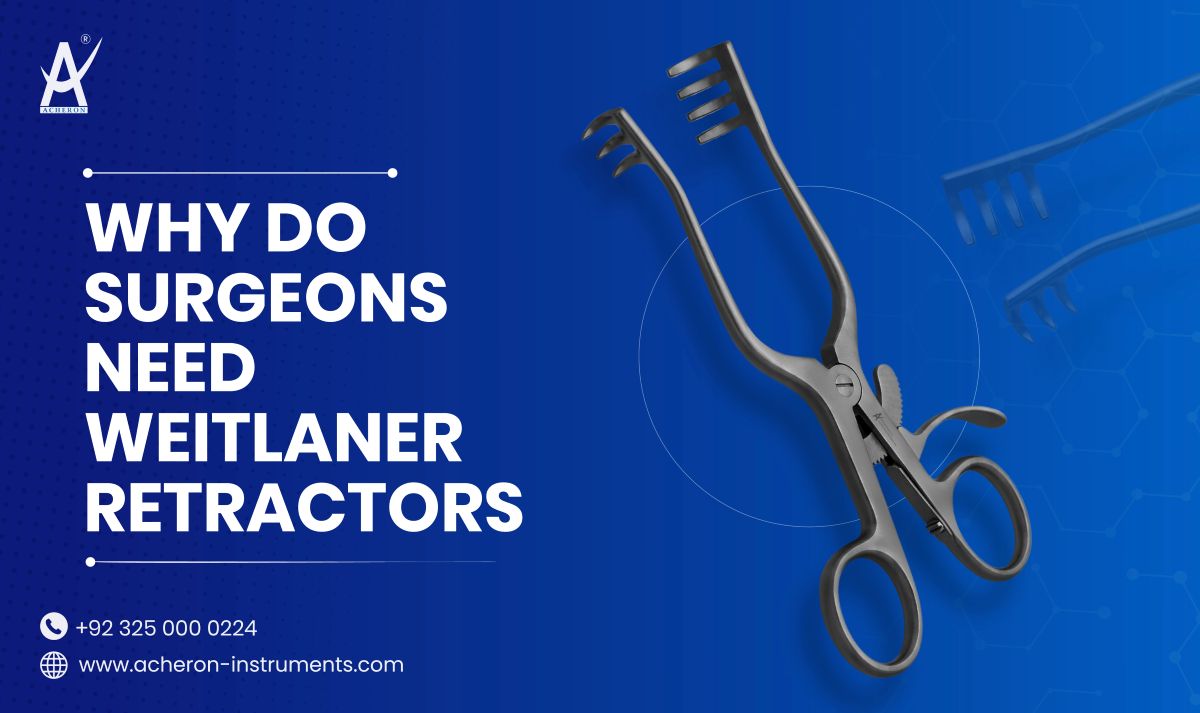
In surgical procedures, visibility matters the most, as it makes the operation more efficient, accurate, and safe. Surgeons must clearly see the area they are working on while keeping surrounding tissues safely positioned away from the surgical site. Weitlaner retractors are one of the most useful general surgery instruments because they help surgeons hold tissue open and keep the surgical field visible. So, why do surgeons need Weitlaner retractors? The answer lies in their ability to improve surgical access. Moreover, this guide examines what the Weitlaner retractor is, why surgeons rely on it, how it compares with handheld alternatives, and the features and benefits of each.
What Is a Weitlaner Retractor?
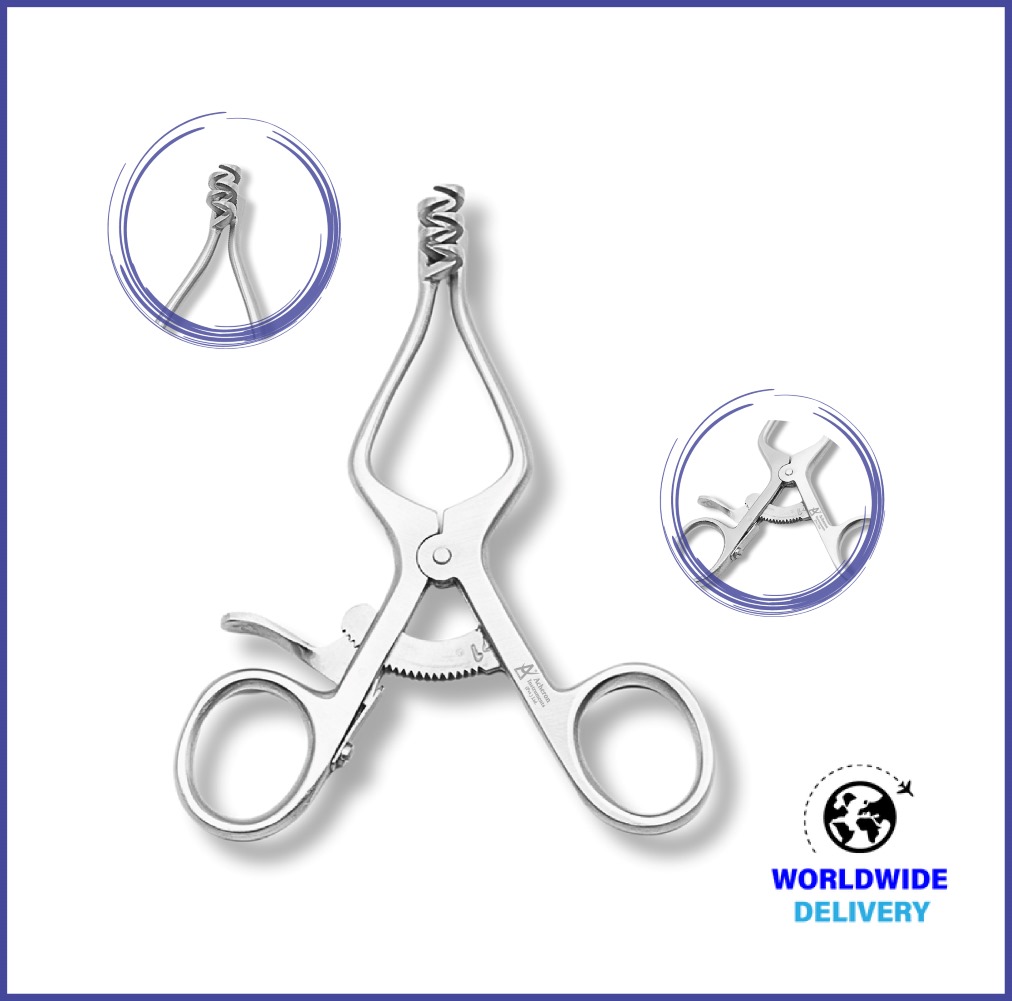
The Weitlaner retractor is an essential self-retaining instrument primarily used to separate and hold back delicate tissues, providing maximum exposure of deep surgical areas. It usually has finger-ring handles, a ratchet locking system, and curved or straight arms ending in prongs. These prongs may be sharp or blunt, depending on the type of tissue being retracted and the procedure being performed. Moreover, the Weitlaner retractor is used in multiple applications, such as spinal, neurosurgical, orthopedic, and general surgical procedures. The following are the key features of the Weitlaner retractor:
-
Self-retaining ratchet mechanism: Locks the retractor blades in position once opened, eliminating the need for manual force to maintain retraction.
-
Hinged, crossed-arm frame: Provides outward tension that keeps tissue margins separated throughout the procedure.
-
Curved, sharp, or blunt tines: Available in both configurations; sharp tines anchor into dense tissue, while blunt tines are used in more delicate anatomical regions.
-
Multiple size variants: Ranging from small (pediatric or superficial use) to large (deep-tissue orthopedic and spinal procedures).
-
Stainless steel construction: Ensure autoclave compatibility, corrosion resistance, and long-term durability.
Advantages of Using the Weitlaner Retractor
The Weitlaner retractor offers a defined set of advantages that directly support surgical efficiency and patient safety. The following are the key advantages of the Weitlner retractor that help medical professionals achieve successful surgical outcomes.
-
Hands-free retraction: Maintain consistent tissue exposure without requiring an assistant to hold the retractor throughout the procedure.
-
Stable, adjustable positioning: The ratchet lock allows incremental adjustment, enabling the surgeon to customize the degree of retraction as the procedure evolves.
-
Reduced operative fatigue: Eliminates the physical demand placed on assistants holding manual retractors during extended procedures.
-
Improved visualization: Delivers unobstructed access to anatomical structures, facilitating accurate dissection and hemostasis.
-
Versatile tine options: Sharp and blunt configurations allow the instrument to be matched to tissue type and procedural requirements.
-
Autoclave-compatible materials: Stainless steel construction supports high-level sterilization protocols consistent with operating room standards.
-
Cost-effective instrument lifespan: Properly maintained Weitlaner retractors withstand repeated sterilization cycles, reducing long-term instrument replacement costs.
Why Do Surgeons Need Weitlaner Retractors?
Medical professionals require Weitlaner retractors because open surgical procedures generate an ongoing conflict between the need for tissue management and the need for operative freedom. Without a mechanism to hold incisions open independently, one pair of hands must be dedicated entirely to retraction, a significant constraint in complex or time-sensitive cases. Furthermore, the Weitlaner retractor resolves this problem by:
-
Freeing the surgical assistant to perform suction, irrigation, suturing, or instrument handling rather than holding a static retraction.
-
Maintaining consistent tension on tissue margins without the variability caused by fatigue or positional shifts.
-
Reduces operative time by avoiding retractor repositioning or handoff.
-
Supporting single-surgeon procedures in settings where full assistant coverage is unavailable.
-
Providing reliable exposure in anatomically confined spaces, such as the posterior cervical spine, wrist, or knee.
Furthermore, the ratchet mechanism of the Weitlaner retractor allows the surgeon to adjust retraction depth and width during the procedure, a level of intraoperative adaptability that static manual retraction cannot consistently achieve.
Surgical Applications and Benefits
Among a wide range of surgical retractors, the Weitlaner retractors are used across a wide range of procedures that require stable tissue separation and clear visualization. Their self-retaining design makes them especially useful in surgeries involving small, deep, or narrow operative fields.
-
Orthopedic Surgery
Holds back dense muscle layers and periosteum (thick bone-covering tissue) during small-joint exposures, such as open reductions of ankle or wrist fractures. Sharp prongs securely bite into muscular tissue to prevent the instrument from slipping under heavy bone-drilling or hammering vibrations. You can explore our complete range of orthopedic surgery instruments for more options.
-
Spinal Surgery
It is used extensively in superficial exposures, such as the initial phases of a microdiscectomy or anterior cervical discectomy. It retracts the skin, subcutaneous fat, and paraspinal muscle layers, providing a stable, hands-free channel that allows the surgeon to insert deep spinal speculums or microscopes safely.
-
Neurosurgery
Essential during craniotomies for holding back dense scalp flaps and in peripheral nerve repairs (like carpal tunnel or ulnar nerve transposition). Blunt-pronged versions are favored here to maintain a wide, steady field of view without risking accidental puncture to adjacent nerves or major arteries.
-
General Surgery
Ideal for small, localized deep-tissue interventions such as inguinal hernia repairs, appendectomies, or saphenous vein stripping. It maintains a consistent, clear view of the fascial layers and anatomical rings without crowding the small incision site with assistant hands.
-
Veterinary Surgery
Weitlaner retractors are essential veterinary surgery instruments used to hold tissue open and improve visibility during surgical procedures. Highly utilized due to limited operating room staff. It acts as a reliable extra pair of hands in small-animal orthopedic procedures (such as cruciate ligament repairs) or soft-tissue procedures, stabilizing incisions through thick animal hide and dense muscle groups.
-
Plastic and Reconstructive Surgery
It is used during deep-tissue dissections like microvascular tissue transfers, cleft palate repairs, or scar revisions. Because it can lock into place under highly calibrated, static tension, it prevents erratic tissue stretching, helping preserve the integrity of fragile dermal margins.
Furthermore, the clinical benefits across specialties are consistent: improved visualization of target structures, reduced dependence on assistant positioning, and maintenance of a stable operative field throughout the procedure.
Weitlaner Retractor vs. Hand-Held Retractor
Both Weitlaner retractors and hand-held retractors are used to improve surgical exposure, but they differ in design, handling, and practical use.
|
Feature |
Weitlaner Retractor |
Hand-Held Retractor |
|
Retraction type |
Self-retaining |
Manually held |
|
Assistant required |
Usually not required after placement |
Usually required throughout use |
|
Stability |
Provides fixed, consistent retraction |
Depends on the assistant’s grip and positioning |
|
Adjustability |
Ratchet mechanism |
Adjusted manually in real time |
|
Best use |
Small to medium incisions, deep exposure, longer procedures |
Broad exposure, dynamic tissue movement, short procedures |
|
Fatigue factor |
Reduces assistant fatigue |
Can cause fatigue during long operations |
|
Tissue control |
Maintains steady tension |
Allows flexible repositioning as needed |
Where to Find a High-Quality Weitlaner Retractor
High-quality Weitlaner retractors should be sourced from reliable surgical instrument suppliers that follow recognized manufacturing and sterilization standards. At Acheron Instruments, we provide a dependable range of surgical instruments designed to meet the practical needs of hospitals, clinics, surgical centers, and healthcare professionals. Our Weitlaner retractors are crafted with precision, durability, and reliable handling in mind, making them a valuable choice for procedures that require stable tissue retraction and clear surgical exposure.
Whether you need sharp or blunt tine options, different sizes, or instruments suitable for general, orthopedic, spinal, or veterinary applications, Acheron Instruments offers quality solutions for modern surgical practice. Explore our range of surgical instruments today, then contact us to find the right tools for your practice.
Conclusion
Surgeons need Weitlaner retractors because they provide stable, hands-free tissue retraction and improve visibility during surgical procedures. Their self-retaining ratchet mechanism allows the instrument to hold tissues apart without constant manual support, helping the surgical team work more efficiently and with greater control. From orthopedic and spinal procedures to general and veterinary surgery, the Weitlaner retractor remains a practical and dependable instrument. At Acheron Instruments, we offer a wide range of surgical instruments, including Weitlaner retractors designed for precision, durability, and reliable performance. Explore our website today to equip your surgical team with the tools needed for optimal outcomes.

-1790596974.jpg)