In orthopedic surgery, what the surgeon can see largely determines the quality of the result. A poorly exposed field makes it difficult to cut a socket, seat an implant, or reduce a fracture accurately. This is why retractors are so important in these surgeries. Among the hand-held bone retractors on an orthopedic tray, few are as versatile as the Darrach retractor. In this guide, we explain what the Darrach retractor is, how its design works, and where it is used.
What Is a Darrach Retractor?
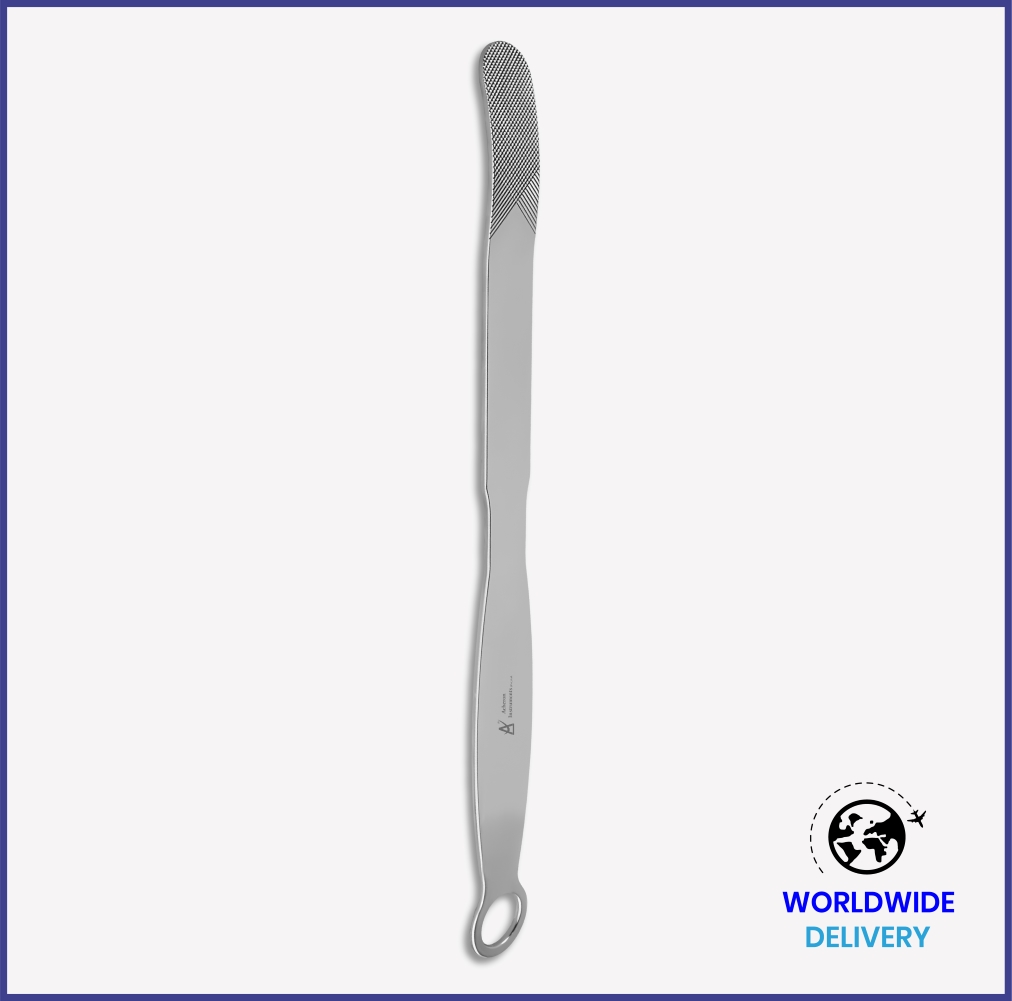
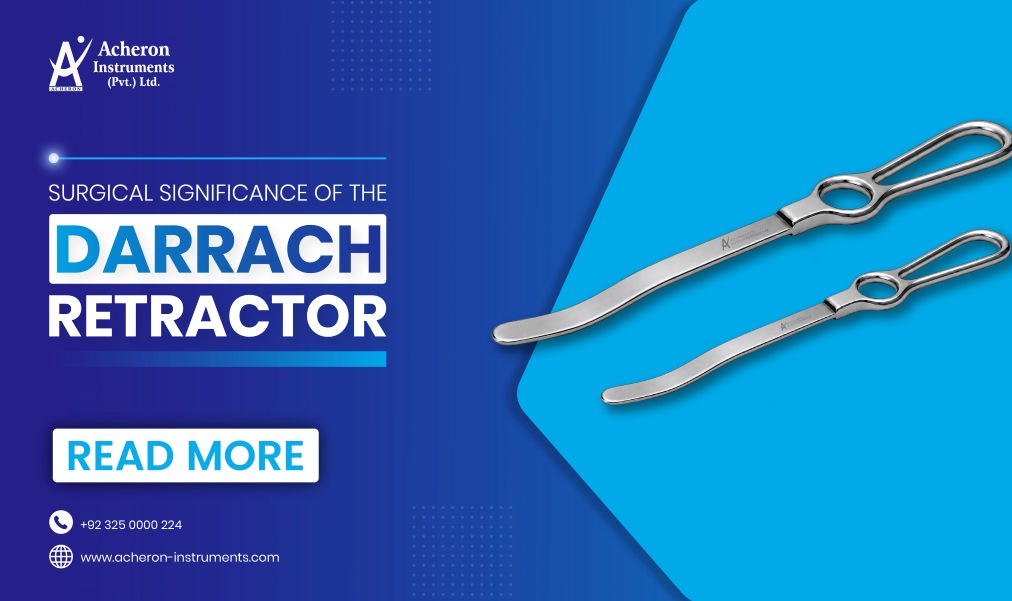
A Darrach Retractor is an essential orthopedic and neurosurgery instrument used to retract, manipulate, and elevate delicate tissues, periosteum, and bone. It is primarily used in procedures involving long bones, small joints, and delicate periosteal tissues, especially during surgeries of the wrist, forearm, ankle, and hand. Furthermore, it consists of a long handle and a flat, gently curved blade that ends in a slightly concave, spoon-like tip. The tip can slide along bone, beneath the muscle or capsule, and act as a lever to hold structures out of sight. The following are the primary uses of the Darrach retractor:
-
Helps provide visibility during shoulder, knee, and joint repair or replacement procedures.
-
Facilitates the elevation of delicate tissue and periosteum off bone.
-
Lifts and manipulates a bone segment, such as the humeral head or proximal femur.
-
Used in open reduction and internal fixation (ORIF) of wrist fractures or distal radioulnar joint (DRUJ) reconstructions.
-
Holds soft tissue structures, such as neurovascular bundles and tendons.
Feature & Benefits
Each feature of the Darrach exists for a clinical reason. Understanding them helps surgeons and procurement teams judge quality.
-
Serrated or Cross-Hatched Tip: Prevents slipping off cortical bone or periosteum, ensuring stable, reliable retraction.
-
Curved or L-Shaped Blade Tip: Easily hooks around rounded bone shafts, such as the radius, ulna, or humerus.
-
Blunt, Beveled Edges: Protects nearby tendons, nerves, and vascular bundles from accidental tearing or sharp trauma.
-
Variety of Blade Widths & Lengths: Adapts seamlessly to diverse surgical approaches, from small hand and wrist joint surgeries to larger shoulder exposures.
-
Ergonomic Ring Handle: Provides maximum leverage with minimal effort, reducing hand fatigue for surgeons.
Surgical Significance of the Darrach Retractor
Why has this relatively simple instrument remained on orthopedic trays for decades? Its significance rests on five clinical advantages.
-
Superior Exposure in Deep, Bony Fields
Joint surgery is performed in deep spaces surrounded by thick muscle. The Darrach retractor allows the operating team to open and hold those spaces, giving the surgeon a direct view of the articular surface, implant bed, or fracture line.
-
Protection of Vital Structures
A well-placed Darrach does more than move tissue aside. It also serves as a shield. With the blade placed between bone and soft tissue, it helps keep neurovascular structures, tendons, and the capsule clear of saws, reamers, and osteotomes.
-
Less Instrument Clutter
Because the Darrach can retract, elevate, and lever, it can sometimes replace two or three instruments. Fewer instruments in the wound means more working room and a cleaner field.
-
Controlled, Gradual Force
The long handle provides a mechanical advantage. The assistant can apply measured, gradual force instead of sudden pulls, which helps minimize soft-tissue trauma.
-
Adaptability to Anatomy
With straight, bent, narrow, and wide variants available, surgical teams can choose the instrument that best fits the patient's size, the approach, and the structure being retracted.
Clinical Applications Across Orthopedic Procedures
1. Shoulder Surgery
During shoulder arthroplasty (anatomic and reverse), the Darrach retractor is commonly used to:
-
Lever and deliver the humeral head into the wound for preparation.
-
Retract the deltoid and surrounding soft tissue.
-
Expose the humeral neck for the osteotomy cut.
Furthermore, for anterior shoulder stabilization, the Darrach retractor is often used together with a dedicated Bankart Retractor, which is designed to retract the humeral head and expose the anterior glenoid rim.
2. Hip Surgery
In total hip arthroplasty and hemiarthroplasty, the Darrach helps to:
-
Lever the proximal femur into view for broaching and implant seating.
-
Retract the capsule and short external rotators.
-
Elevate soft tissue around the femoral neck.
On hip trays, the Darrach is commonly placed alongside the Hohmann Retractor, the Bent Hohmann Retractor, the Bennett Retractors, and the Acetabular Retractor for full femoral and acetabular exposure.
Knee Surgery
In knee arthroplasty and open knee procedures, a narrow Darrach can help retract the patellar tendon or soft tissue around the tibial plateau. It works alongside dedicated knee retractors such as the Blount Knee Retractor.
Where to Find a High-Quality Darrach Retractor
Acheron Instruments is committed to manufacturing Darrach retractors that provide surgeons with reliable exposure, precision, and control during various procedures. Manufactured from premium-grade German surgical stainless steel, our range of surgical retractors is engineered for durability, smooth handling, and consistent performance in demanding surgical environments. Reasons to choose Acheron Instruments for high-quality Darrach Retractors include the following:
-
ISO, FDA, and CE-certified for international quality compliance
-
Manufactured using premium German surgical stainless steel
-
Designed for reliable tissue retraction and improved surgical exposure
-
Backed by a comprehensive five-year warranty
-
Supported by responsive 24/7 customer service
-
Competitively priced for hospitals, clinics, and surgical facilities
Contact us today to learn more about Darrach Retractor specifications, available sizes, customized solutions, and bulk purchasing options tailored to the needs of your healthcare facility.
Conclusion
Darrach retractors are an important tool used in various surgical procedures. Their curved, spoon-like blade, dual role as retractor and elevator, and range of sizes make them a key instrument in shoulder, hip, and trauma surgery. They give surgeons clear exposure, protect vital structures, and support precise, efficient procedures.
Ready to equip your orthopedic tray? Explore the Acheron Instruments Darrach Retractor or request a quote for bulk and custom orders today.

-1790596974.jpg)