
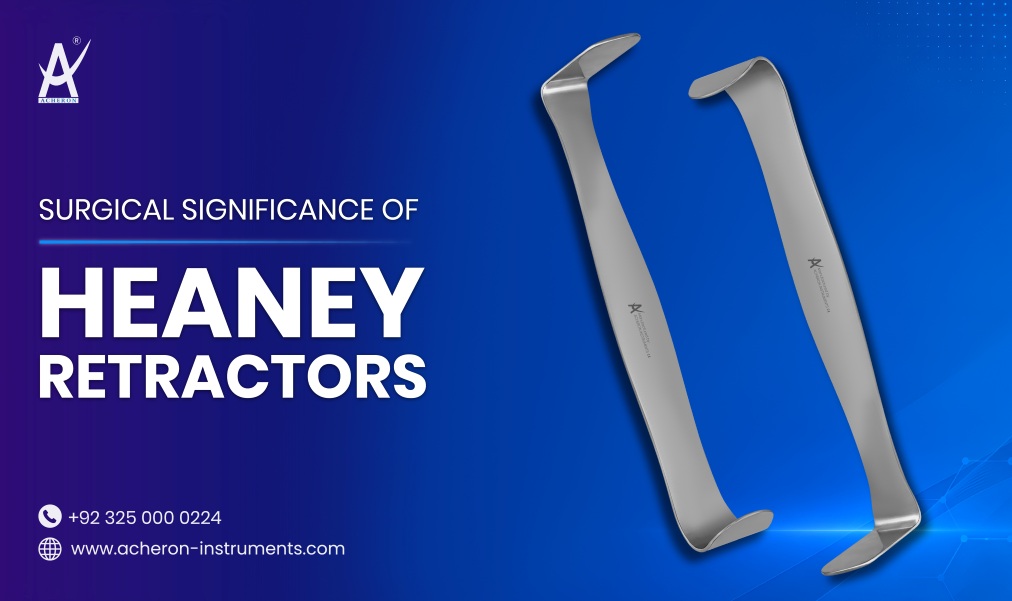
In gynecological and pelvic surgery, exposure is essential for a safe and successful procedure. Surgeons must clearly see deep anatomical structures while protecting delicate nearby organs, blood vessels, and soft tissues. This is why the Heaney retractor has earned its reputation as one of the most trusted instruments in the operating room. Named after American gynecologist Dr Noble Sproat Heaney, this deceptively simple handheld instrument has shaped vaginal hysterectomies and related pelvic procedures for nearly a century. Furthermore, this guide will break down the design, types, clinical applications, and surgical significance of Heaney retractors, along with everything you need to know about selecting this instrument for the operating room.
What Is a Heaney Retractor?
A Heaney retractor is a handheld gynecological surgical instrument used to retract and hold delicate tissue, such as the vaginal walls, bladder, peritoneum, and uterus, giving the surgeon a clear, unobstructed view of the surgical area. It is an essential instrument in vaginal hysterectomy trays and is widely used in gynecologic, urologic, and general pelvic surgery.
Additionally, unlike self-retaining retractors that lock into place, the Heaney retractor is a manual retractor, meaning an assistant or the surgeon holds it throughout the procedure. This hands-on control is one of its key advantages because the angle, depth, direction, and amount of retraction can be adjusted immediately as the surgical field changes. Such responsive positioning helps maintain optimal exposure while minimizing unnecessary pressure on delicate surrounding tissues.
Design and Anatomy of the Heaney Retractor
The design of the Heaney retractor is simple but highly effective:
-
Blade: A curved, thin, flat blade, sometimes described as L-shaped or right-angled, designed to slide along tissue planes without cutting or tearing.
-
Atraumatic edges: The blade edges are smooth and blunt, which minimizes trauma to delicate structures, such as the bladder wall and peritoneum.
-
Handle: A solid, ergonomically shaped central handle, often positioned at a right angle to the blade, keeps the assistant’s hand out of the direct line of sight.
-
Hooked handle end: Many designs include a hooked terminal end, preventing the instrument from slipping during long procedures.
-
Length: Most Heaney retractors measure approximately 9 to 11 inches (commonly 10 inches) overall.
This combination of a broad, curved blade and a comfortable right-angle handle allows the instrument to retract deep pelvic structures without obstruction.
Types and Variations of Heaney Retractors
Several variations of the Heaney retractor exist to suit different surgical needs. Choosing between these variations usually comes down to the specific procedure, the depth of the surgical field, and surgeon preference.
-
Standard Heaney Retractor: Single curved blade, used for general vaginal and pelvic retraction.
-
Heaney-Simon Retractor: Combines features of the Heaney and Simon retractor designs, featuring an angled blade and grooved grip, often used specifically for retracting the vaginal walls.
-
Double-Ended Heaney Retractor: Features two different blade shapes or sizes on either end, typically one L-shaped and one curved blade, so the surgical team can switch working ends without reaching for a second instrument.
-
Heaney Hysterectomy Retractor: A variant with the blade and handle set at a right angle, specifically designed to retract the vaginal walls during hysterectomy without blocking the view.
Surgical Significance and Clinical Applications
The surgical significance of the Heaney retractor lies in its ability to provide safe, stable, and adjustable exposure in a surgical field that is often narrow, deep, and crowded with delicate anatomical structures. Key applications include the following:
-
Vaginal hysterectomy: The primary and most well-known use, retracting the vaginal walls, bladder, and peritoneum to expose the uterine pedicles and ligaments for clamping and ligation.
-
Myomectomy: Providing exposure during removal of uterine fibroids via a vaginal approach.
-
Pelvic floor repair and prolapse surgery: Retracting tissue during procedures such as anterior/posterior colporrhaphy.
-
Bladder suspension procedures: Helping expose the bladder neck and surrounding tissue.
-
General abdominal and pelvic surgery: Used more broadly whenever deep, stable retraction of soft tissue is required, including in some urologic procedures.
Heaney Retractor vs Other Vaginal Retractors
|
Retractor |
Primary Use |
Distinguishing Feature |
|
Heaney Retractor |
Vaginal hysterectomy, pelvic floor repair |
Curved/L-shaped blade, right-angle handle, multiple blade sizes |
|
Heaney-Simon Retractor |
Vaginal wall retraction |
Angled blade with grooved grip |
|
Vaginal wall exposure, posterior retraction |
Deep, duckbill-shaped blade |
|
|
Abdominal surgery |
Long, curved blade for deep abdominal cavities |
While each of these instruments serves a retraction function, the Heaney retractor’s specific blade geometry and handle placement make it particularly well suited to the narrow, deep operative field of vaginal surgery, where instruments must retract tissue without crowding the limited working space.
How to Choose the Right Heaney Retractor
Surgical teams and procurement staff should consider the following when selecting Heaney retractors for their instrument trays:
-
Blade size: Match the blade width and depth to the typical patient population and procedure type performed at the facility.
-
Single vs double-ended design: Double-ended retractors reduce the number of individual instruments needed on a tray.
-
Handle comfort: Ergonomic, hooked handles reduce assistant fatigue during lengthy procedures.
-
Material grade: Verify surgical-grade stainless steel construction and manufacturer warranty terms.
-
Set compatibility: Ensure the retractor complements other instruments already used in the facility’s vaginal hysterectomy or pelvic surgery tray.
Why Choose Acheron Instrument for Heaney Retractor
Selecting the appropriate surgical retractor involves more than ordering a familiar instrument name. Buyers must also assess blade dimensions, working length, surface finish, handle design, material, reprocessing requirements, and compatibility with existing surgical trays.
Acheron Instruments provides surgical instrument solutions for healthcare facilities, distributors, and procurement professionals seeking dependable instruments for demanding clinical environments. When discussing Heaney retractors with Acheron Instruments, buyers can request information about:
-
Available blade shapes and sizes
-
Single- and double-ended configurations
-
Overall and working lengths
-
Instrument material and surface finish
-
Product catalog details
-
Packaging and supply options
-
Reprocessing documentation
-
Private-label or distributor requirements, where available
-
Quotations for individual instruments or larger orders
Contact Acheron Instruments to discuss product specifications, availability, purchasing requirements, and customized supply needs.
Conclusion
The surgical significance of Heaney retractors goes far beyond their simple, unassuming appearance. Rooted in nearly a century of surgical innovation, this instrument continues to play a central role in vaginal hysterectomy and broader pelvic surgery by delivering safe, atraumatic, and adjustable tissue retraction. For surgical teams, understanding the design variations, correct applications, and proper care of the Heaney retractor is essential to maintaining both surgical efficiency and patient safety in the operating room. At Acheron Instruments, we provide a wide range of high-quality surgical retractors manufactured to support accuracy, durability, and reliable performance in demanding clinical environments. Visit our website today for more information!


-1790596974.jpg)