Few parts of the body contain as many vital structures in such a small space as the neck. The trachea, esophagus, carotid arteries, jugular veins, thyroid gland, and delicate nerves such as the recurrent laryngeal nerve all lie within a few centimeters of the cervical spine. However, surgery in this region requires a clear, stable view and careful protection of everything around the operative site. The cervical retractor provides both.
This guide explains the surgical significance of a cervical retractor, why it matters so much in neck and spine surgery, the main types, and best practices for safe retraction.
What Is a Cervical Retractor?
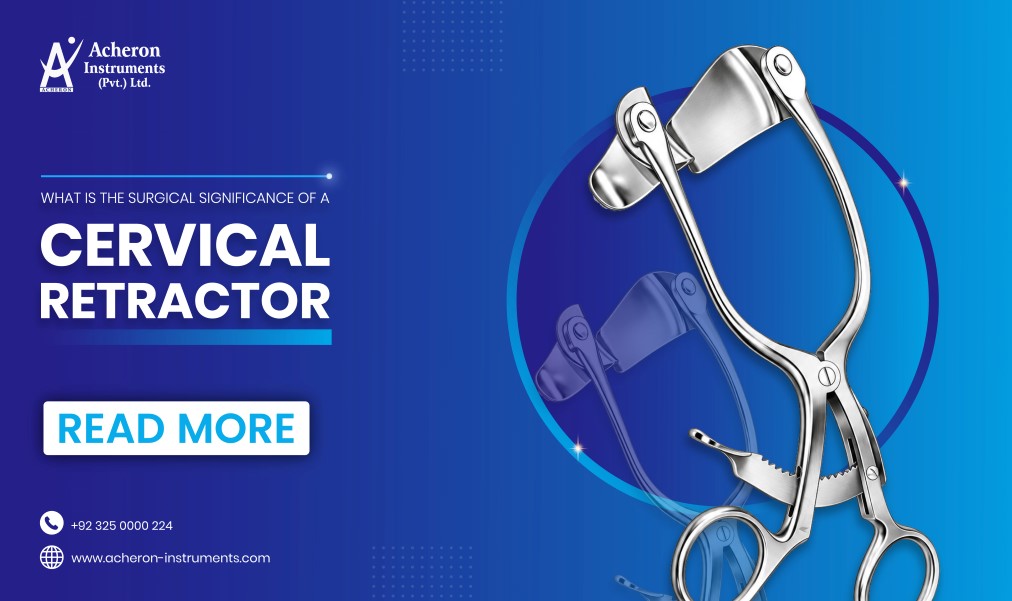
A cervical retractor is a specialized instrument used in spine surgery to retract delicate tissues, including blood vessels, muscle, the esophagus, and the trachea, to provide clear access to the cervical spine. It is primarily used in cervical spine surgery, especially anterior procedures such as anterior cervical discectomy and fusion (ACDF), corpectomy, and cervical disc replacement. Furthermore, cervical retractors come in two broad forms:
-
Handheld retractors, which an assistant holds and adjusts manually.
-
Self-retaining retractors, which lock open on their own through a frame, ratchet, or spring mechanism.
In modern spine practice, self-retaining systems with interchangeable blades are standard for the main part of the operation. Handheld retractors still play a supporting role during the initial dissection.
Key Features of a Cervical Retractor
Before going into the clinical details, the following features define a well-designed cervical retractor system.
-
Self-retaining ratchet frame to maintain consistent tissue distraction hands-free, eliminating surgeon fatigue.
-
Interchangeable blade configurations allow customizable blade depth and width tailored to each patient’s anatomy.
-
Blunt or smooth blade tips help ensure that sensitive visceral structures are securely retracted. The Cervical Self-Retaining Dull Retractor is a good example of this atraumatic design.
-
Toothed and smooth blade options for secure placement with less tissue trauma.
-
Low-profile frame to maximize working corridor visibility.
-
Ergonomic handles and controls for easy adjustment during surgery.
Why Is the Cervical Retractor Surgically Significant?
The importance of a cervical retractor comes down to one balance: maximum exposure with minimum harm. The instrument must open a corridor wide enough for complex spinal work while protecting the structures pushed aside. Here is how it achieves that.
1. Creates a Clear and Stable Surgical Corridor
In an anterior cervical approach, the surgeon works through a natural plane between the carotid sheath on one side and the trachea and esophagus on the other. Left alone, this space collapses almost immediately.
The cervical retractor keeps it open. With the vertebral bodies and disc spaces steadily visible, the surgeon can perform each key step with confidence. These steps include removing the disc, decompressing the spinal cord and nerve roots, preparing the endplates, and placing grafts, cages, or plates. Accessory instruments such as the Caspar Drill Guide are often used within this corridor during plate fixation.
2. Protects the Neck’s Most Vulnerable Structures
The blades of the cervical retractor serve as a physical barrier between the surgical field and the esophagus, trachea, blood vessels, and nerves. This protection is especially important when high-speed drills, rongeurs, and other sharp instruments are being used. Toothed medial-lateral blades are typically placed beneath the edges of the longus colli muscles, which anchor them securely and keep them from slipping onto delicate tissue.
3. Frees the Surgical Team to Focus
Holding a handheld retractor for an hour or more is tiring, and tired hands can shift. Even small movements may blur the view or create uneven pressure on tissue. A self-retaining cervical retractor removes that variable. It maintains consistent tension, so the surgeon and assistant can focus fully on the operation. This advantage becomes even greater in multilevel procedures, where operating time naturally increases.
4. Supports Precision and Better Outcomes
Cervical spine surgery is performed just millimeters from the spinal cord, so precision is critical. A stable, well-lit, unobstructed field supports accurate decompression and proper implant placement. Good exposure can also reduce unnecessary tissue handling and help make the procedure more efficient. When working near the nerve roots, surgeons may also use a dedicated instrument such as the Campbell Nerve Root Retractor.
5. Enables Less Invasive Approaches
As spine surgery shifts toward smaller incisions and faster recovery, retractor design has kept pace. Low-profile blades and compact frames help surgeons create enough working space through a smaller opening. Radiolucent retractors add another advantage, which includes allowing the team to confirm the correct spinal level with fluoroscopy without disturbing the setup.
Common Types of Cervical Retractors
No single retractor suits every patient or procedure. Here are the main categories surgical teams rely on.
|
Type |
Description |
Typical Use |
|
Handheld retractors (Cloward hand retractor, Army-Navy, Langenbeck) |
Simple, versatile instruments held by an assistant. |
Initial dissection and superficial exposure |
|
Self-retaining anterior cervical retractors (Caspar-style & Cloward-style systems) |
Frame-based systems with interchangeable, locking blades. |
ACDF, corpectomy, cervical disc replacement |
|
Medial-lateral blades |
Usually toothed; anchored under the longus colli. |
Moving the esophagus/trachea and carotid sheath aside |
|
Cranial-caudal blades |
Smooth, often blunt-tipped blades. |
Retracting tissue above and below the target level |
|
Posterior cervical retractors (Weitlaner, Gelpi, Meyerding-style, cerebellar retractors) |
Self-retaining instruments for posterior muscle retraction. |
Laminectomy, laminoplasty, posterior fusion |
|
Radiolucent retractor systems |
Carbon fiber or similar imaging-friendly materials. |
Procedures requiring intraoperative imaging |
For posterior spinal exposure beyond the cervical region, the Taylor Spinal Retractor is another commonly used option. You can also browse the complete range of orthopedic instruments for spine procedures.
Best Practices for Safe Cervical Retraction
Experienced surgical teams use several strategies to keep the benefits of retraction while limiting its risks:
-
Use only the force needed.
-
Choose the right blade length.
-
Anchor blades securely.
-
Consider intermittent release.
-
Keep retraction time efficient.
-
Coordinate with anesthesia.
-
Recheck blade position.
Why Choose Acheron Instruments for Cervical Retractors
At Acheron Instruments, we design and manufacture surgical instruments built for precision, durability, and dependable everyday performance. Our range of surgical retractors is designed to meet the practical demands of medical professionals. Our cervical retractors are made from high-grade stainless steel by skilled craftsmen, inspected for alignment and function, and backed by internationally recognized certifications. You can choose high-quality forceps from Acheron Instruments for several reasons:
-
ISO, FDA, and CE-certified for international quality compliance.
-
Manufactured using premium German surgical stainless steel.
-
Each step of the manufacturing process is monitored against international standards.
-
Backed by a comprehensive five-year warranty.
-
Supported by responsive 24/7 customer service.
-
Competitively priced for hospitals, clinics, and surgical facilities
Conclusion
The cervical retractor is essential in neck and spine surgery. It maintains a stable surgical corridor, protects the esophagus, trachea, blood vessels, and nerves, and provides surgeons with the clear view they need for precise, efficient work. Choosing a well-designed, properly maintained retractor directly supports safer procedures and better patient outcomes. To equip your surgical team with reliable, certified instruments, explore Acheron Instruments’ range of cervical retractors or request a quote today.