
In the surgical world, surgical instruments directly impact procedural safety, surgeon comfort, field visibility, and the overall performance of the complex procedure. Among the many tools surgeons rely on, the Deaver retractor stands out as a simple yet highly effective instrument that improves access and visibility during procedures. Its unique shape and versatility make it indispensable in abdominal and thoracic surgeries. This guide explores the primary uses of the Deaver retractor, its features, benefits, and advantages, and compares it with other retractors.
What is a Deaver Retractor?
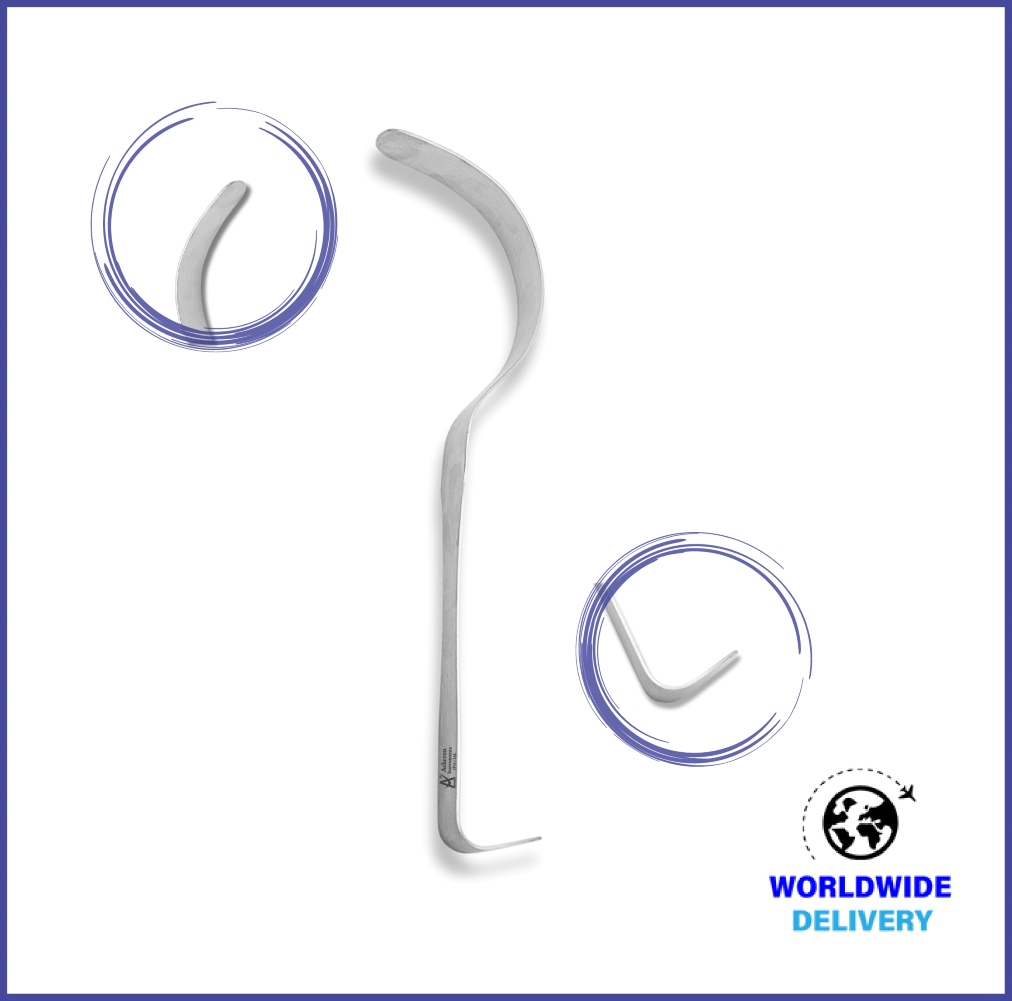
The Deaver retractor is a versatile, handheld surgical instrument primarily used to hold back and manipulate deep, heavy tissues, such as the liver, stomach, or bowel, during various procedures. Among a wide range of surgical retractors, the Deaver retractor is widely recognized by its distinctive shape. Moreover, the design of the Deaver retractor enables surgical assistants to maintain deep-tissue retraction without causing excessive localized pressure on delicate organs. Key characteristics include the following:
-
Distinctive “C” or question-mark shape to provide deep surgical access.
-
Thin, flat blade profile for maximizing the visible workspace for the surgeon.
-
Smooth, atraumatic edges to protect soft internal structures from bruising or laceration.
-
Ergonomic flat grip handle for controlled surgical assistance.
-
Multiple width options to suit all anatomical variations and patient needs.
Primary Uses of Deaver Retractor in Surgery
The Deaver retractor has a unique shape and versatility, making it indispensable in abdominal and thoracic surgeries and many other procedures, enhancing surgical efficiency and safety.
1. Abdominal Surgery
In deep abdominal surgeries, visibility is paramount. The Deaver retractor is routinely used to retract the abdominal wall and to hold organs aside. The Bookwalter retractor is another common type of retractor used in abdominal surgery.
- Cholecystectomy: Used to safely retract the right lobe of the liver, exposing the gallbladder and biliary tract.
- Vagotomy: Assists in holding the stomach and liver to provide clear access to the vagus nerve.
- Bowel Resection: Keeps the intestines safely out of the operative field while surgeons operate on specific segments of the gastrointestinal tract.
2. Thoracic Surgery
Thoracic procedures require careful navigation around the heart, lungs, and rib cage. The Deaver retractor helps manage these delicate structures. Moreover, unlike the Deaver retractor, the Allison retractor is primarily designed for grasping and retracting lung tissue rather than for providing broad, deep retraction of soft tissues and organs.
- Chest Wall Retraction: Holds back the muscular layers of the chest wall to expose the thoracic cavity.
- Lung Deflection: Gently depresses lung tissue to allow surgeons access to the mediastinum or posterior chest wall.
- Esophageal Procedures: Retracts surrounding tissue to provide clear access to the esophagus during repair or resection.
3. Gynecological Procedures
Gynecological surgeries often occur deep within the pelvic cavity, necessitating reliable deep-tissue retraction. The Heaney Simon retractor is another preferred tool for GYN or OB procedures.
- Hysterectomy: Retracts the bladder and anterior abdominal wall, offering an unobstructed view of the uterus and surrounding ligaments.
- Pelvic Lymphadenectomy: Holds the bowel and other pelvic organs safely away from the surgical site during lymph node removal.
- Ovarian Cystectomy: Provides the necessary exposure to safely isolate and remove large cysts without damaging adjacent structures.
4. General Surgery Procedures
Beyond specialized fields, the Deaver retractor is heavily utilized in general surgical applications.
- Hernia Repair: Assists in deep ventral hernia repairs by holding back the thick layers of the abdominal wall.
- Appendectomy: While smaller retractors are often used, a narrow Deaver can help retract the cecum in patients with challenging anatomy.
- Trauma Surgery: Rapidly exposes deep internal bleeding sources by powerfully retracting heavy muscle and tissue mass.
Advantages of Using a Deaver Retractor
The following are the advantages of using the Deaver retractor for achieving superior surgical outcomes.
-
Prevent tearing or puncturing of delicate tissues and organs.
-
Allows for deep cavity retraction that shallower retractors cannot achieve.
-
Suitable for a wide range of procedures, from thoracic to pelvic surgeries.
-
High-quality manufacturing ensures the instrument withstands repeated use and autoclave sterilization.
-
By effectively managing heavy organs, it provides an unobstructed operative field.
Comparison with Other Retractors
Selecting the appropriate surgical tool requires understanding how the Deaver retractor compares to other common retractors. The following table compares the Deaver retractor with commonly used surgical retractors.
|
Retractor Type |
Best Suited For |
Typical Surgical Applications |
|
Deaver Retractor |
Deep cavity and heavy organ retraction |
Abdominal, Thoracic, Gynecological |
|
Richardson Retractor |
Shallow to medium tissue retraction |
Appendectomies, superficial abdominal walls |
|
Kelly Retractor |
Sturdy tissue and muscle retraction |
General surgery, orthopedic procedures |
|
Balfour Retractor |
Hands-free, prolonged abdominal exposure |
Major laparotomies, open pelvic surgeries |
While the Richardson and Kelly retractors are excellent for holding back the edges of an incision, the Deaver excels at reaching deeper into the cavity to move entire organs out of the way.
Where to Buy High-Quality Deaver Retractor
Acheron Instruments is a trusted manufacturer and supplier of premium surgical tools, including the Deaver Retractor. Our instruments are produced in compliance with US FDA standards, EU MDR requirements, ISO 13485 certification, and CE regulations, ensuring exceptional safety, performance, and durability through repeated sterilization cycles. Trusted by surgeons and healthcare providers worldwide, Acheron Instruments continues to set high standards in surgical excellence by offering:
-
High-Quality Manufacturing: Our instruments undergo rigorous testing to ensure durability and precision, providing long-lasting performance in surgical settings.
-
Customization Options: We understand that every procedure and patient is different. We offer customizable options to cater to specific surgical needs.
-
Competitive Pricing: With competitive pricing models, we offer cost-effective solutions without compromising quality.
-
Global Distribution: Our worldwide network ensures reliable and timely delivery, even for custom orders, maximizing operational efficiency for your facility.
Looking for a high-quality Deaver retractor you can trust in every procedure? Choose Acheron Instruments for precision-crafted surgical tools designed to meet global standards. Contact us today to request a quote, discuss customization options, or place your order with confidence.
Conclusion
A successful surgical procedure depends heavily on the skill of the surgeon and the quality of the instruments used. The Deaver retractor remains a fundamental tool for achieving deep, atraumatic retraction, thereby enhancing surgical efficiency and safety across multiple disciplines. By equipping your operating rooms with precision-engineered tools, you empower your surgical teams to perform at their best. Furthermore, reach out to Acheron Instruments today to explore our comprehensive range of customizable surgical instruments.
FAQs
What is a Deaver retractor used for?
A Deaver retractor is primarily used to retract organs and delicate tissues during surgery, especially in abdominal and thoracic procedures. It provides clear visibility and access to deeper anatomical structures.
What is the difference between Richardson and Deaver?
The main difference between the Richardson and Deaver retractors lies in their shape and depth. While the Deaver retractor has a curved blade for deep internal organ retraction, the Richardson retractor has a right-angled blade for more superficial or moderate-depth retraction.
What sizes do Deaver retractors come in?
Deaver retractors are available in various lengths and blade widths, allowing surgeons to choose the appropriate size based on the procedure and required depth.

-1790596974.jpg)