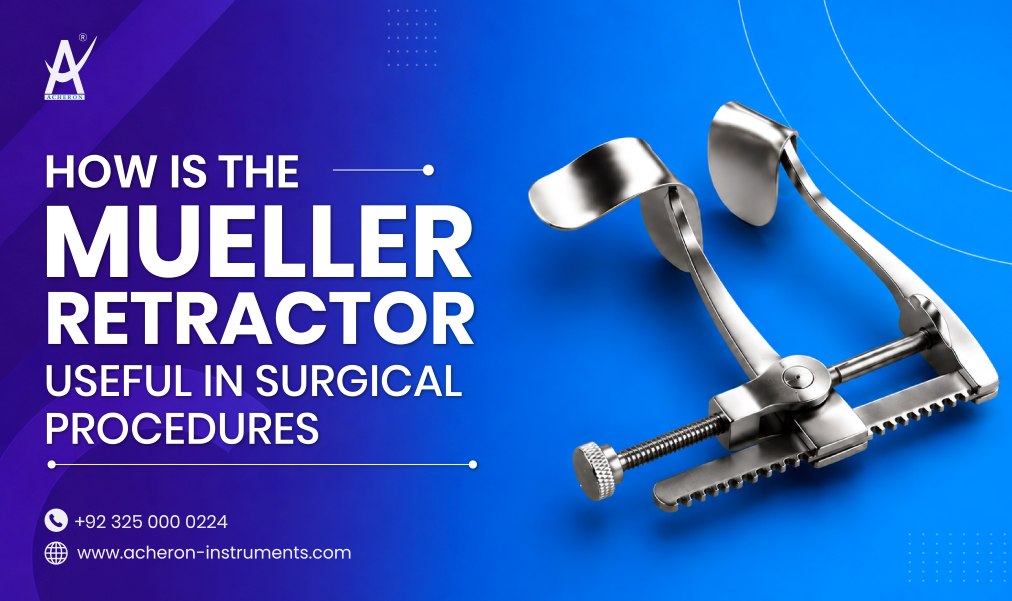
Surgical procedures depend on precision, visibility, and controlled access to anatomical structures. Among the many surgical instruments used in operating rooms, retractors play an essential role in maintaining a clear surgical field by separating tissues and structures. One commonly used handheld retractor in surgical practice is the Mueller retractor, which is used in a wide range of orthopedic, plastic, general, and neurosurgical procedures. This guide explores what the Mueller retractor is, its design characteristics, how it is used during surgery, and why it remains an important instrument in modern surgical procedures.
What Is a Mueller Retractor?
A Mueller retractor is a handheld surgical instrument designed to hold back soft tissues, muscles, skin, and other anatomical structures during surgical procedures. The instrument usually consists of a handle attached to a blade with one or more curved or angled ends that assist in retracting tissue. Among a wide range of surgical retractors, this retractor belongs to a broader category of manual retractors, meaning a surgical assistant typically holds it in place throughout the procedure. Furthermore, Mueller retractors are manufactured in multiple sizes and configurations to accommodate different surgical requirements. The following are the primary uses of the Mueller retractor that help improve surgical efficiency and procedural accuracy:
-
Enhance visibility within the surgical field by retracting tissues to access deeper anatomical structures.
-
Support delicate surgical procedures that require controlled tissue manipulation.
-
Facilitate orthopedic procedures by exposing bones, joints, tendons, and surrounding tissues.
-
Aid plastic and reconstructive surgeries in which precise soft-tissue handling is essential.
-
Help surgical teams maintain continuous exposure during lengthy operations.
Design Features of the Mueller Retractor
The effectiveness of the Mueller retractor largely comes from its practical and ergonomic design. Key structural and ergonomic features include the following.
-
Curved blade tip: Features a curved, angled blade that hooks beneath tissue layers without causing unnecessary trauma to surrounding structures.
-
Flat or fenestrated blade options: Depending on the surgical application, blades may be solid or perforated to reduce tissue pressure and enhance visualization.
-
Ergonomic handle: The handle provides a firm, comfortable grip during long procedures, reducing hand fatigue for the assistant.
-
Varying blade widths: Available in various sizes, with narrow blades for delicate or deep procedures and wider blades for broader tissue retraction in open surgery.
-
Smooth edges: Blade edges are polished to reduce tissue damage at the retraction site.
-
Lightweight construction: Despite being made of stainless steel, the instrument is designed to be lightweight yet durable.
-
Autoclave compatibility: All components withstand high-temperature sterilization cycles.
How the Mueller Retractor Works During Surgery
Knowing how the instrument operates during surgery explains its widespread use. The process generally involves the following:
-
Positioning the retractor beneath or around soft tissue.
-
Applying controlled traction.
-
Maintaining exposure of the target surgical area.
-
Allowing surgeons to work safely on deeper structures.
The assistant holding the instrument can adjust tissue tension as needed throughout the procedure. This dynamic control distinguishes handheld retractors, such as the Mueller retractor, from fixed retractors. Other than the Mueller retractor, you can select a Senn retractor or Volkmann retractor depending on the specific procedural requirements.
Applications of Mueller Retractors in Surgical Procedures
Orthopedic Surgery
-
Mueller retractors are frequently used in joint and bone procedures, including hip replacements, knee surgeries, and fracture repairs.
-
They retract muscle bellies and soft tissues around bony structures, providing surgeons with clear access to the joint capsule or fracture site.
-
Their durability makes them particularly suited to the physical demands of orthopedic environments, where retractors often bear significant opposing tissue forces.
-
Common use cases include anterior hip approach surgeries and tibial plateau procedures.
Plastic and Reconstructive Surgery
-
In plastic surgery, precision is crucial, making the Mueller retractor’s smooth, atraumatic blade edges particularly beneficial.
-
Surgeons use it to retract the skin and subcutaneous tissue during procedures such as breast reconstruction, skin grafting, and scar revision.
-
The retractor’s ability to maintain gentle, consistent tension helps protect delicate tissues and reduces the risk of postoperative scarring.
-
In facial and neck procedures, smaller variants of the Mueller retractor provide controlled access without compromising cosmetic outcomes.
General Surgery Procedures
-
General surgeons rely on Mueller retractors during abdominal and thoracic procedures to hold back tissue layers and organs.
-
They are commonly used in open appendectomies, hernia repairs, and exploratory laparotomies.
-
In procedures involving the abdominal wall, the retractor helps maintain separation between fascial layers, providing surgeons with a stable, unobstructed working area.
-
Mueller retractors are also used to protect surrounding organs, such as the bowel or bladder, from inadvertent contact with surgical instruments.
Neurosurgical Procedures
-
In neurosurgery, access precision is critical given the proximity to nerve tissue, the spinal cord, and the brain.
-
Mueller retractors are used in spinal surgery to retract the paraspinal muscles and expose vertebral structures for decompression, fusion, or disc procedures.
-
Their controlled retraction reduces the risk of muscle necrosis from prolonged tension.
-
Smaller-profile Mueller retractor designs are used in minimally invasive spinal approaches where space is severely restricted.
Benefits of Using the Mueller Retractor
The following are the advantages of the Mueller retractor that make it highly valuable in various surgical procedures.
-
Improved surgical visibility: Consistent retraction keeps the operative field clear, reducing errors and improving overall procedural accuracy.
-
Reduced operative time: Clear access helps surgeons work more efficiently, which can reduce time under anesthesia for patients.
-
Tissue protection: The curved blade and smooth edges minimize trauma to retracted tissue, contributing to faster postoperative recovery.
-
Versatility across specialties: A single instrument type, available in multiple sizes, serves across orthopedic, plastic, general, and neurosurgical disciplines.
-
Durability and cost-effectiveness: High-grade stainless steel construction means Mueller retractors withstand decades of use when properly maintained.
Where to Find High-Quality Surgical Retractors
Acheron Instruments is dedicated to manufacturing surgical retractors that deliver precision, reliability, and efficiency across a broad range of surgical procedures. Our instruments are developed using premium-grade surgical stainless steel and engineered to meet the demands of modern healthcare environments. From tissue retraction and dissection to specialized surgical applications, our retractors are designed to deliver consistent performance and long-term durability. Reasons to choose Acheron Instruments for high-quality surgical forceps include the following:
-
ISO, FDA, and CE-certified for international quality compliance
-
Manufactured using Premium German stainless steel
-
Backed by a comprehensive five-year warranty
-
Supported by a responsive 24/7 customer service
-
Competitively priced to deliver cost-effective solutions for healthcare facilities
Contact us today to learn more about product specifications, customized solutions, and bulk purchasing options tailored to meet the needs of your facility.
Conclusion
The Mueller retractor remains an important instrument in surgical procedures because it provides controlled tissue retraction, improves visibility, and facilitates efficient access to operative areas. Although it appears to be a simple tool, its contribution to surgical precision and patient care is significant. By maintaining clear exposure while minimizing tissue disruption, the Mueller retractor supports safer, more effective surgical outcomes. At Acheron Instruments, we provide high-quality surgical instruments manufactured with precision, durability, and reliability in mind. You can visit our website and check out our general surgery catalogue, or explore our other surgical instrument categories designed to meet the diverse requirements of healthcare professionals.

-1790596974.jpg)