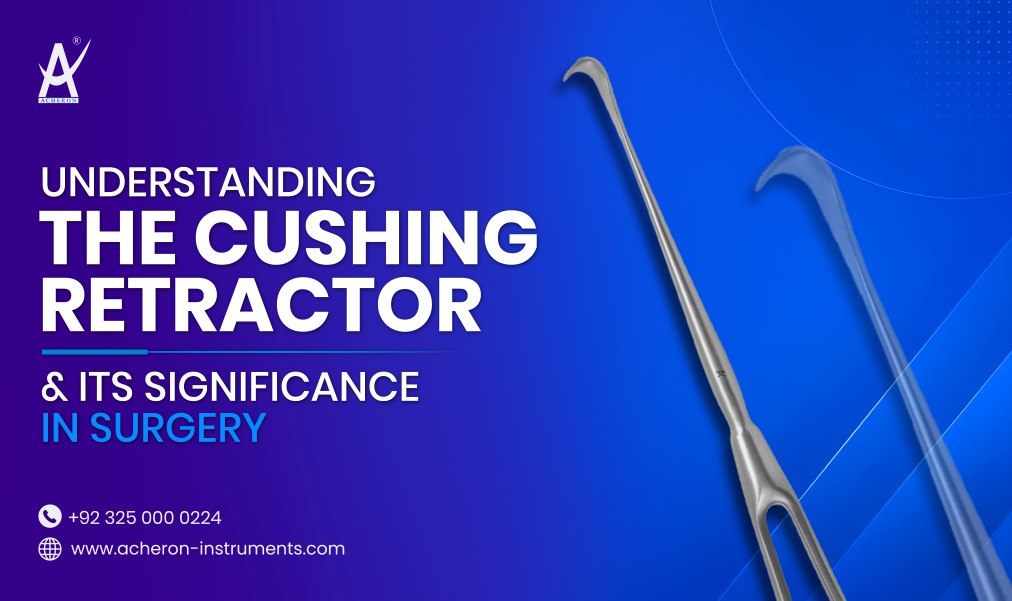
Among the many specialized surgical instruments in a modern operating room, few match the durability and precision of the Cushing retractor. Named after pioneering American neurosurgeon Dr. Harvey Cushing, this hand-held surgical instrument has remained a staple in operating rooms for more than a century. Despite advances in surgical technology, the Cushing retractor continues to play a critical role in procedures ranging from neurosurgery to vascular and general surgery. Depending on its design, it may be used for veins, nerves, soft tissues, or tissue surrounding a surgical opening. In this guide, we'll explore what a Cushing retractor is, its design variations, clinical applications, and why it remains a trusted tool for surgeons worldwide.
What Is a Cushing Retractor?
A Cushing retractor is an essential handheld, non-self-retaining surgical retractor used to hold back tissue, organs, or vascular structures to provide the surgeon with a clear, unobstructed view of the surgical field. Unlike self-retaining retractors, which lock with a ratchet or frame, the Cushing retractor is held manually by a surgical assistant throughout the procedure. It assists surgeons with moving tissue temporarily so they can reach deeper anatomical structures, identify blood vessels, control bleeding, or complete a surgical step.
Furthermore, it is most closely associated with neurosurgery and vascular procedures. However, its versatility has made it a common sight across many surgical specialities, including general, plastic, ENT, and orthopedic surgery.
Characteristics of Cushing Retractor
-
Malleable design: Many Cushing retractors are made from bendable, malleable surgical-grade stainless steel, which allows the blade to be contoured to the specific anatomy of the surgical site.
-
Blunt, rounded edges: Designed to minimize tissue trauma during retraction.
-
Double-ended construction: Many models feature two differently sized blades on opposite ends, giving surgeons flexibility without switching instruments.
-
Lightweight and ergonomic: Built for extended handheld use during long procedures.
Design and Anatomy of the Cushing Retractor
Understanding the physical design of the Cushing retractor helps explain why it remains so widely used.
Blade Shape and Size
Cushing retractor blades are typically flat or gently curved, with smooth, rounded edges to prevent tissue tearing. Blade widths vary depending on the intended use:
-
Narrow blades are used for delicate work, such as retracting veins or small nerves.
-
Wider blades are used to retract larger tissue masses, muscle, or organ structures.
Malleability
One of the defining features of many Cushing retractors is malleability, the ability to bend and hold a shape. This allows the surgeon or assistant to customize the curve to match the contour of the surgical site, which is especially valuable in confined spaces like the cranial cavity.
Handle Design
Handles are typically flat or slightly textured to provide a secure grip, since the instrument is held manually (sometimes for extended periods) rather than clamped in place.
Material
Most Cushing retractors are manufactured from surgical-grade stainless steel, valued for its corrosion resistance, durability, and ability to withstand repeated sterilization cycles. Some premium models use German or Japanese stainless steel for enhanced longevity.
Common Types and Variations
Not all Cushing retractors are identical; the term refers to a family of related instruments. Surgical instrument sets often include several sizes of Cushing retractors to accommodate different stages of a procedure. Common variations include the following:
-
Cushing Vein Retractor: A slim, double-ended retractor designed for gently isolating and retracting veins and delicate soft tissue, commonly used in vascular and general surgery.
-
Cushing Brain Retractor (Spatula): A flat, malleable blade used in neurosurgery to retract brain tissue and the dura mater, allowing access to deeper cranial structures.
-
Cushing Tissue/Vein Hook: A smaller hooked variant used for gently isolating individual vessels or nerves.
Clinical Applications: Where the Cushing Retractor Is Used
Neurosurgery
This is the speciality most closely tied to the Cushing retractor's legacy. Neurosurgeons use it to gently retract brain tissue, allowing safe access to tumors, aneurysms, or other intracranial structures without applying excessive pressure that could damage delicate neural tissue. Cushing vein and decompression retractors may be selected during procedures such as:
-
Craniotomy for brain tumor resection (gliomas, meningiomas)
-
Aneurysm clipping surgery
-
Temporal lobectomy for epilepsy
-
Deep brain stimulation (DBS) electrode placement
-
Spinal cord tumor resection
-
Ventriculoperitoneal (VP) shunt placement for hydrocephalus
Vascular Surgery
In procedures involving veins and arteries, the Cushing vein retractor is used to isolate and hold back vessels, providing a clear operative field while minimizing the risk of vessel trauma. It assists with various procedures such as the following:
-
Carotid endarterectomy
-
Varicose vein stripping/ligation
-
Arteriovenous (AV) fistula creation for dialysis access
-
Vein harvesting for coronary artery bypass grafting (CABG)
-
Peripheral arterial bypass surgery
-
Abdominal aortic aneurysm (AAA) repair
General Surgery
From abdominal procedures to soft tissue dissections, general surgeons frequently use Cushing retractors for their versatility and gentle handling characteristics. It assists with various procedures such as:
-
Cholecystectomy (gallbladder removal)
-
Appendectomy
-
Inguinal or ventral hernia repair
-
Bowel resection/anastomosis
-
Thyroidectomy
-
Exploratory laparotomy
-
Mastectomy
Plastic and Reconstructive Surgery
The precision and gentleness of smaller Cushing retractor variants make them useful in procedures requiring careful tissue handling and minimal scarring. It helps with various procedures, such as the following:
-
Rhytidectomy (facelift)
-
Cleft lip and palate repair
-
Skin flap reconstruction (e.g., after trauma or tumor removal)
-
Scar revision surgery
-
Breast reconstruction
-
Microvascular free tissue transfer
ENT and Other Specialities
Given their range of sizes, Cushing retractors also find use in ear, nose, and throat procedures, as well as select orthopedic applications where soft tissue retraction is needed. Such procedures may include the following:
-
Tonsillectomy and adenoidectomy
-
Tympanoplasty (eardrum repair)
-
Neck dissection (e.g., for head and neck cancer)
-
Sinus surgery (functional endoscopic sinus surgery, FESS)
-
Parathyroidectomy
-
Orthopedic soft-tissue procedures like tendon repair or carpal tunnel release
Cushing Retractor vs Other Common Retractors
This comparison highlights why surgical teams often select a Cushing retractor specifically when gentle, adjustable retraction of delicate structures is required.
|
Feature |
Cushing Retractor |
||
|
Type |
Hand-held, non-self-retaining |
Hand-held, non-self-retaining |
Self-retaining |
|
Common Use |
Neurosurgery, vascular, general |
General surgery |
Orthopedic, general surgery |
|
Malleable |
Often yes |
No |
No |
|
Best For |
Delicate tissue/vessel retraction |
Superficial wound retraction |
Hands-free wound spreading |
Choosing the Right Cushing Retractor
For hospitals, surgical centres, or instrument buyers, several factors matter when selecting Cushing retractors for a surgical tray:
-
Blade width and length suited to the speciality (neurosurgery vs general surgery).
-
Required degree of malleability for the intended procedures.
-
For Material quality, look for certified surgical-grade stainless steel.
-
Single-ended vs double-ended designs, depending on tray space and procedure variety.
-
Manufacturer reputation and compliance with relevant medical device standards.
Source High-Quality Cushing Retractors from Acheron Instruments
Acheron Instruments manufactures precision surgical instruments for hospitals, surgical centres, distributors, and healthcare suppliers worldwide. Our Cushing retractors can be supplied in different lengths, blade widths, finishes, and design configurations according to your surgical and market requirements.
Contact Acheron Instruments to request product specifications, custom manufacturing options, pricing, packaging details, or a quotation for bulk and private-label orders.
Conclusion
The Cushing retractor stands as a testament to how a well-designed, purpose-built instrument can remain clinically relevant for over a century. Its blend of simplicity, adaptability, and gentle tissue handling continues to make it a trusted choice across neurosurgery, vascular surgery, and general surgical practice. At Acheron Instruments, we provide a wide range of high-quality surgical retractors manufactured to support accuracy, durability, and reliable performance in demanding clinical environments. Visit our website today for more information!

-1790596974.jpg)