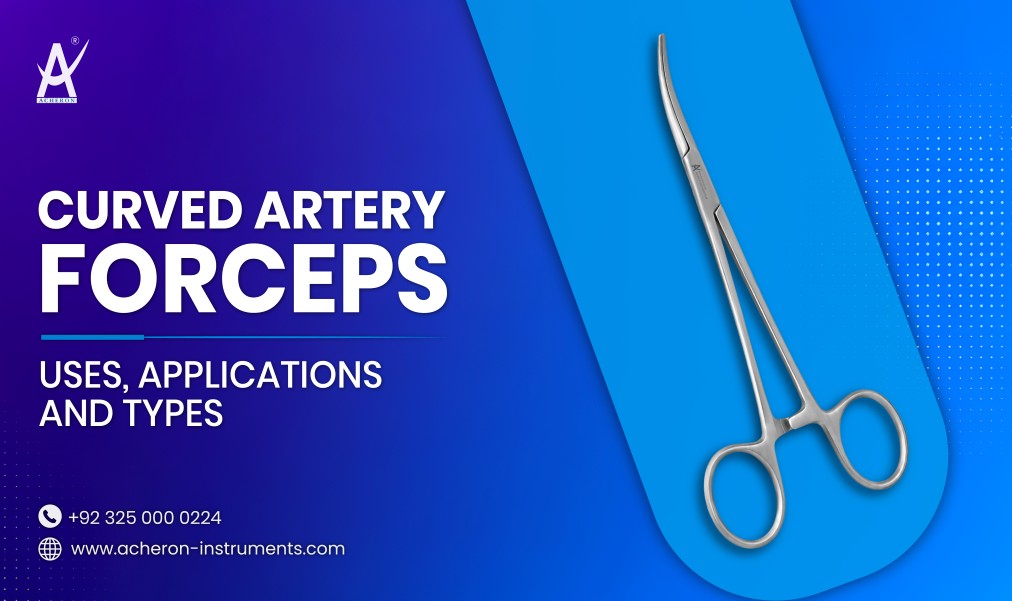
Some specialized surgical instruments, including the Curved Artery Forceps, are preferred by surgeons to control blood flow during various procedures. The curved artery forceps uses are essential in surgical procedures to perform intricate tasks, which include clamping blood vessels and accessing deep surgical areas. Moreover, these forceps stand out due to their unique design and characteristics, which enable them to handle delicate surgeries in multiple settings. In this blog, we will explain the curved artery forceps uses, types, and applications for a better understanding. Let’s delve into the blog!
Do you want to learn more? Read Curved Artery Forceps.
What Are Curved Artery Forceps?
Curved artery forceps, also known as artery clamps or hemostats, are hemostatic forceps used to clamp and compress blood vessels to control excessive bleeding. From a wide range of forceps, these forceps are preferred by surgeons because they clamp the blood vessels without causing any damage or local injury. Furthermore, these forceps come with serrated jaws and a ratchet mechanism that allows the forceps to hold and grip the tissues, blood vessels, and other structures securely. The curved artery clamps are available in multiple sizes, shapes, types, and designs to suit different surgical applications.
Primary Uses
There are various uses of curved artery forceps, which make them a better option to perform delicate surgical procedures. The following are the primary uses of these forceps:
-
Efficiently grasp, clamp, and manipulate blood vessels to prevent blood loss.
-
Facilitate holding delicate tissues without any damage or trauma.
-
Securely grasp and handle soft tissues during suturing or tissue dissection.
-
Assist surgeons in the blunt dissection of tissue planes during abdominal surgeries.
-
Used to temporarily control or stop blood flow in arteries.
-
Grant access and an unobstructed view of the underlying structures.
-
Precisely remove foreign body objects or retrieve clots in particular procedures.
Advantages of Curved Artery Forceps
The following are the advantages of the Curved Artery Forceps:
-
Grant enhanced access to the hard-to-reach or confined surgical spaces.
-
Facilitate a firm grip on the tissues to prevent accidental slippage.
-
Provide better accessibility around bends or curves in the vessels.
-
Available in multiple shapes and sizes to suit various applications.
Features of Curved Artery Forceps
We have discussed the unique features and characteristics of the Curved Artery Forceps in the form of a table. It will help you gain a better understanding of the forceps to make an easy selection
|
Features |
Benefits |
|
Curved Jaw |
Provide access to the deep surgical spaces to manipulate tissues or blood vessels. |
|
Serrated Inner Surfaces |
Efficiently hold the blood vessels with minimal damage. |
|
Tapered Jaws |
Precisely grasp and manipulate delicate tissues during intricate procedures. |
|
Ratchet Locking Mechanism |
Clamp the blood vessels and provide enhanced grip while maintaining consistent pressure. |
|
Narrow Profile |
Provide exposure and an unobstructed view of the underlying structures. |
|
Ergonomic Rings Handle |
Easy and controlled handling during longer procedures. |
Applications in Surgical Procedures
Curved artery forceps are preferred by surgeons to perform and facilitate multiple surgical disciplines:
-
Obstetrics and Gynecology: Used for hysterectomy and C-section procedures.
-
General Surgery: Holding tissues and clamping blood vessels.
-
Cardiovascular Surgery: Manage bleeding and handle vessels.
-
Orthopedic Surgery: Control bleeding in bone and delicate tissue surgeries.
-
ENT Procedure: Facilitate precise tissue dissection.
-
Plastic Surgery: Precisely handle cosmetic procedures.
-
Neurosurgery/ Spinal Procedure: Assist in delicate surgeries in the brain or spinal cord.
-
Urological Procedures: Prevent excessive bleeding during delicate surgeries.
Types of Curved Artery Forceps
There is a wide range of curved artery forceps that surgeons use as per their surgical requirements, but we are going to discuss only a few of them. However, most of these forceps are available in both straight and curved variations. Here are some commonly used curved artery forceps that are mostly preferred by surgeons in a wide range of surgical applications.
Curved Artery Forceps vs. Straight Artery Forceps
Artery forceps are available in both straight and curved variants to assist surgeons in different medical settings. While they share a common fundamental purpose, their distinct designs make them suitable for different surgical scenarios. The following is a table that explains the key differences between the Curved Artery Forceps and Straight Artery Forceps.
|
Features |
Curved Artery Forceps |
Straight Artery Forceps |
|
Jaw Design |
Curve or angle from the shaft. |
Straight and aligned with the shaft. |
|
Access & Visibility |
Access tissues in deep or confined surgical fields. |
Direct access to superficial vessels or tissues. |
|
Maneuverability |
Control around bends, curves, and anatomical obstructions. |
Tissue clamping in straightforward anatomical planes. |
|
Primary Use |
Clamping vessels in deep body cavities. |
Clamping large vessels in open surgical fields. |
|
Risk Factors |
Grant uneven pressure on straight vessels. |
Less adaptable to curved spaces. |
|
Applications |
Preferred for intricate procedures. |
Preferred for general surgery. |
Conclusion
In conclusion, you must choose the right artery forceps for the best patient health outcomes and enhanced surgical efficiency. Moreover, the curved artery forceps have their distinctive characteristics and uses that make them a fundamental instrument for every operating room toolkit. Therefore, you must consider curved artery forceps uses, applications, and features before purchasing for your healthcare facility. These forceps are used to clamp and compress small or large blood vessels for efficient hemostasis. The most important thing you must not compromise on is the quality of your curved artery forceps because they are used in the most delicate surgeries that require utmost care and safety.

-1790596974.jpg)